
SEO

Is SEO Worth It for Your Business? A Founder’s Guide to SEO ROI in 2026

Is SEO Worth It for Your Business A Founder's Guide to SEO ROI in 2026

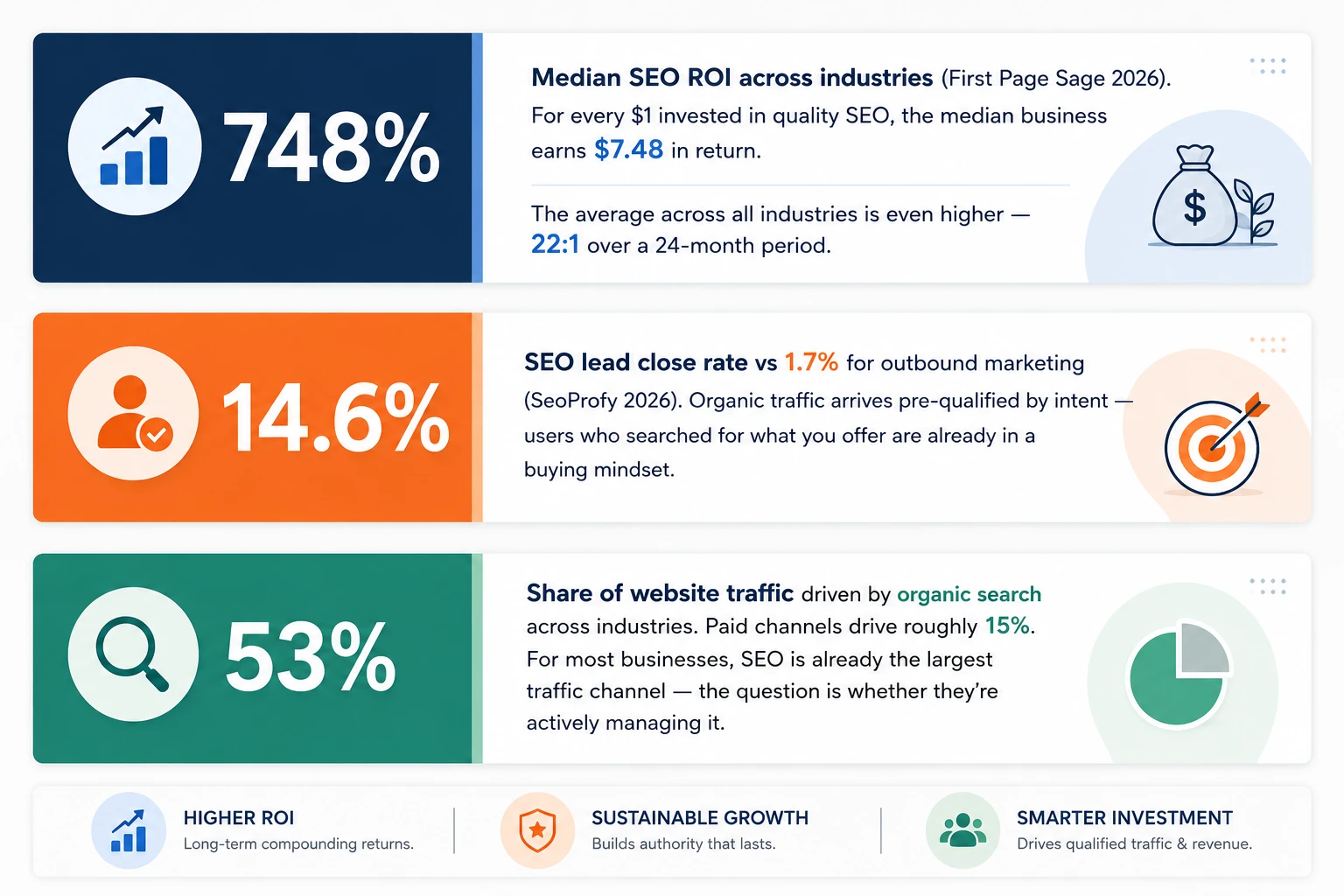
Yes, SEO is worth it in 2026 — but the honest answer depends on your business model, timeline, and execution quality. The median SEO ROI is 748%, and SEO leads close at 14.6% vs 1.7% for outbound. The critical caveat for founders: SEO takes 3–6 months to show measurable results and 12–24 months to compound meaningfully. It is a capital allocation decision, not a quick-win tactic.

Introduction

Most founders asking ‘is SEO worth it’ are really asking a more specific question: should I allocate budget and time to SEO right now, or is there a faster path to revenue?

That’s a capital allocation question, not a marketing question. And it deserves a direct, data-grounded answer rather than the vague ‘it depends’ that most SEO content provides.

The short answer: SEO delivers the highest long-term ROI of any digital marketing channel — 748% median return, 22:1 average over 24 months, and a lead close rate of 14.6% versus 1.7% for outbound marketing. But it’s also the slowest channel to show results. The founders who benefit from SEO are those who invest early enough that the compounding effect works in their favor — not those who turn to it when paid acquisition becomes too expensive.

This guide gives you the framework to make that capital allocation decision with actual data, not opinions.

5 KEY TAKEAWAYS

  • The median SEO ROI is 748% — but it takes 12–24 months to realize. Founders who start early capture the compounding effect. Those who wait face a longer runway to the same outcome.
  • SEO leads close at 14.6% vs 1.7% for outbound — organic traffic is pre-qualified by intent in a way no paid or cold channel replicates.
  • SEO is the only marketing channel where stopping spend doesn’t immediately stop results — built rankings continue generating traffic and leads without ongoing cost.
  • In 2026, SEO worth depends heavily on execution quality — mediocre SEO has negative ROI. Precise, systematic SEO has the highest ROI in digital marketing.
  • The correct question for founders is not ‘is SEO worth it’ but ‘is SEO worth it now’ — stage, business model, and competitive landscape determine the answer.

The SEO ROI Data Founders Actually Need

Before evaluating whether SEO is worth it for your business, understand the performance benchmarks that industry data supports in 2026.

The ROI varies significantly by industry and business model. Service businesses with high customer lifetime value — legal, financial services, healthcare, SaaS — see the highest SEO ROI because a single converted customer justifies months of investment.
The SEO ROI Data Founders Actually Need

The ROI varies significantly by industry and business model. Service businesses with high customer lifetime value — legal, financial services, healthcare, SaaS — see the highest SEO ROI because a single converted customer justifies months of investment.

Industry / ModelAvg. SEO ROIWhyTimeline
SaaS / Subscription700%+Low marginal cost per customer; content compounds into pipeline12–18 months
Professional Services (Legal/Finance)250–400%High LTV per client; one conversion covers months of spend6–12 months
eCommerce / Retail300%+Direct revenue attribution; product pages track to transactions6–12 months
Healthcare / Dental220%High local competition; strong review + local SEO dependency4–8 months
Real Estate400%+Single commission covers extensive investment; local search is dominant6–12 months
Early-stage B2B SaaS (<$1M ARR)Uncertain / delayedLimited domain authority; faster wins from founder-led content18–24 months

Is SEO Worth It for Your Stage? A Founder's Decision Framework

The ROI data is compelling — but aggregate ROI data obscures the stage-specific answer. SEO is not equally worth it at every point in a company’s lifecycle.

Pre-Product Market Fit

SEO is rarely the right primary channel before PMF. The 3–6 month minimum timeline to measurable organic results means you’ll iterate through multiple positioning pivots before the content you’re creating even ranks. Paid search and direct sales provide faster feedback loops on messaging and offer fit.

The exception: if your ICP searches for your solution category, publishing founder-led content that demonstrates expertise can build brand recognition and backlinks that accelerate SEO once you’re ready to invest. Keep the investment minimal, a few high-quality pieces per month rather than a full SEO program.

Post-PMF, Pre-Scale

This is where SEO investment starts earning its highest ROI. You’ve confirmed what customers want. Now you need a channel that scales without linearly increasing cost.

The strategic case: paid acquisition costs have risen 28% year-over-year on Google Ads and 47% on Meta in 2026. The businesses growing most efficiently in this environment are the ones that built organic traffic as a counterweight to paid dependency. Every founder who deferred SEO investment now faces higher acquisition costs and a longer SEO runway to results simultaneously.

  • Start SEO when you can afford to wait 6 months for measurable ROI — if you need traffic next month, paid is the right lever
  • Prioritize high-intent commercial keywords over informational content — blog traffic that doesn’t convert to pipeline doesn’t justify the investment at this stage
  • Use GSC data from day one — even early-stage organic traffic reveals which queries are driving intent and which content resonates before you invest at scale

Scaling Stage

At scale, SEO is non-negotiable. Paid acquisition costs scale linearly with growth. SEO cost-per-lead decreases as domain authority compounds — meaning the 100th lead from organic costs significantly less than the first. The brands paying $300+ CPL on paid search while watching their SEO traffic compound at $8 CPL are experiencing the gap between founders who started SEO early and those who didn’t.

SEO vs Paid Search: The Capital Allocation Comparison

For founders deciding where to allocate marketing budget, the most relevant comparison is SEO versus paid search — the two channels competing for the same queries.

FactorSEOPaid Search (Google Ads)
Time to first results3–6 monthsDays
Cost modelFixed investment; declining CPL over timeVariable; CPL rises as competition increases
What happens when you stopTraffic continues (rankings persist)Traffic stops immediately
Lead quality14.6% close rate (pre-qualified by intent)Variable — depends on targeting precision
Long-term ROI748% median; 22:1 average at 24 months~200% typical; constrained by rising CPC
Competitive moatRankings are defensible; compound over timeNo moat — competitors can outbid you
Best forLong-term growth channel; recurring queriesLaunch traffic; time-sensitive campaigns

The strategic answer for most founders: run paid search while building SEO. Paid search funds the business now. SEO builds the asset that reduces paid dependency over time. The mistake is either running only paid (no long-term asset building) or running only SEO (too slow to fund early growth). The optimal allocation shifts from paid-heavy at early stages to SEO-heavy as organic traffic compounds.

When SEO Is NOT Worth It

A realistic assessment of SEO ROI requires acknowledging the conditions where it doesn’t deliver adequate return — particularly relevant for founders evaluating capital allocation.

Conditions Where SEO ROI is Negative or Insufficient
    • Your search category doesn’t exist yet. If customers don’t know to search for what you offer, there are no queries to rank for. SEO requires existing search demand.
    • You need revenue in the next 90 days. SEO’s minimum realistic timeline for measurable results is 3–6 months, with meaningful compounding at 12–24 months. If your runway requires faster payback, paid acquisition is the correct channel now.
    • You’re in a winner-take-all market with dominant incumbents. If the top 3 results are Amazon, Wikipedia, and a funded competitor with 10 years of domain authority, the cost to compete organically exceeds the return for most early-stage businesses.
    • Mediocre execution. Low-quality content, poor technical SEO, and no link-building produces near-zero ROI regardless of investment level. The 748% median ROI assumes quality execution — not $500/month content mills.

What Quality SEO Actually Looks Like in 2026

The gap between positive and negative SEO ROI is almost entirely an execution quality gap. The 2026 search environment — with Google’s AI systems, AI Overviews, and elevated E-E-A-T standards — has made the quality bar for effective SEO significantly higher than it was 3 years ago.

What quality SEO looks like for a founder evaluating a program or agency:

  • Technical foundation first — indexation, Core Web Vitals, site structure. No content investment compounds on a technically broken site
  • High-intent keyword targeting — commercial and transactional queries that connect to pipeline, not only informational traffic that inflates vanity metrics
  • E-E-A-T signals throughout — named authors with verifiable credentials, original research or data, first-hand experience demonstrated in content
  • Systematic link building — authoritative third-party citations, not low-quality directory submissions
  • GSC-driven optimization loop — using real search data to identify what’s ranking, what’s close, and what needs refreshing
The Founder-Led Content Advantage

Research confirms founder-led content drives stronger SEO performance for startups than agency-produced content — because founders have genuine expertise, authentic perspective, and access to proprietary insights that no hired writer can replicate. In 2026, Google’s E-E-A-T signals specifically reward first-hand experience and demonstrated domain expertise. A founder writing candidly about their industry, customers, and product competes better against generic SEO content than any volume content strategy. Start there.

How to Measure SEO ROI for Your Business

Founders often struggle to evaluate SEO ROI because organic attribution is messier than paid. A paid ad converts and the conversion is logged. An organic visitor reads three blog posts over six weeks, attends a webinar, then converts — and the attribution often goes to Direct or Last Touch, not to the SEO program that initiated the relationship.

A practical SEO ROI measurement stack for founders:

  • Connect GSC to GA4 — the landing page view surfaces which pages drive organic sessions alongside engagement and conversion data
  • Set up GA4 conversion events for every meaningful action: form submissions, demo requests, trial signups, calls
  • Tag GSC-to-website URL with UTM parameters to track GBP and organic sources distinctly in GA4
  • Use the First User Source dimension in GA4 reports — not Last Touch — to attribute pipeline to the organic channel that initiated the relationship
  • Calculate CPL monthly: total SEO spend (content + technical + links) ÷ organic-attributed leads. Compare against paid CPL for the same conversion type
  • At 12 months, compare the cumulative CPL trend — SEO CPL should be declining as traffic compounds; paid CPL will be stable or rising

Conclusion: Is SEO Worth It?

For the right business at the right stage with quality execution: yes, unambiguously. The 748% median ROI, 22:1 average return, and 14.6% lead close rate make SEO the most efficient long-term growth channel in digital marketing. No other channel builds an asset that appreciates while you sleep.

For founders evaluating the decision now, the question is not whether SEO delivers ROI — the data is unambiguous. The question is whether you can afford the 3–6 month minimum before measurable results appear, whether search demand exists for your category, and whether you have the budget for quality execution rather than commodity content.

If the answer to those three questions is yes, the strategic risk is not investing in SEO — it’s deferring it. Every month of deferral is a month of compounding that goes to a competitor. The businesses with the strongest organic channels in 2028 are the ones making the SEO investment decision today.

Frequently Asked Questions

Is SEO worth it for small businesses in 2026?

Yes, particularly for service businesses with high customer lifetime value. Small businesses focusing on local SEO and long-tail keywords in their niche compete effectively against larger competitors because Google rewards relevance and authority, not just budget. The average small business sees approximately 275% ROI over 12 months of consistent SEO investment, with service businesses (legal, healthcare, home services) seeing 250–400%+ returns. The critical success factor is targeting high-intent commercial keywords rather than broad informational traffic.

50% of businesses see measurable ROI in organic traffic within 3 months. 70% experience significant improvement within 6 months (Digital World Institute 2026). Meaningful compounding — where SEO becomes a primary revenue driver — typically requires 12–24 months of consistent investment. The timeline depends heavily on domain authority at the start, competitive landscape, execution quality, and keyword targeting precision. Founders should build the 6-month minimum wait into their financial modeling when evaluating SEO as a channel.

Long-term: yes. SEO delivers 748% median ROI vs approximately 200% for paid search (SeoProfy 2026). The critical difference is the compounding effect: SEO traffic continues after investment stops; paid traffic stops the moment spending stops. In 2026, average Google Ads CPCs have risen 28% year-over-year, making paid acquisition increasingly expensive at scale. The optimal strategy for most founders is running paid ads for immediate revenue while building SEO as the long-term, lower-CPL channel — then shifting budget toward SEO as organic traffic compounds.

A minimum viable SEO program for a startup requires $1,500–3,000/month covering technical SEO maintenance, 4–6 pieces of high-quality content per month, and basic link acquisition. Below this threshold, execution quality typically produces minimal measurable results. Above $5,000/month, programs can accelerate with more content volume and systematic link building. The most efficient founder approach is investing in a few high-quality pieces per month (founder-led content where possible) rather than high-volume low-quality content, which has declined significantly in effectiveness following Google’s 2025–2026 core updates.

Track three metrics in sequence. First, impressions in GSC (increasing impressions confirm Google is surfacing your pages for more queries — the leading indicator). Second, clicks and organic sessions (growing clicks confirm rankings are translating to traffic). Third, conversion-attributed pipeline from organic (GA4 with First User Source attribution — the ROI metric). The correct measurement cadence: check GSC impressions and clicks weekly, run the full GA4 organic attribution report monthly. A healthy SEO program shows rising impressions first, then clicks 4–8 weeks later, then pipeline 2–3 months after that.