
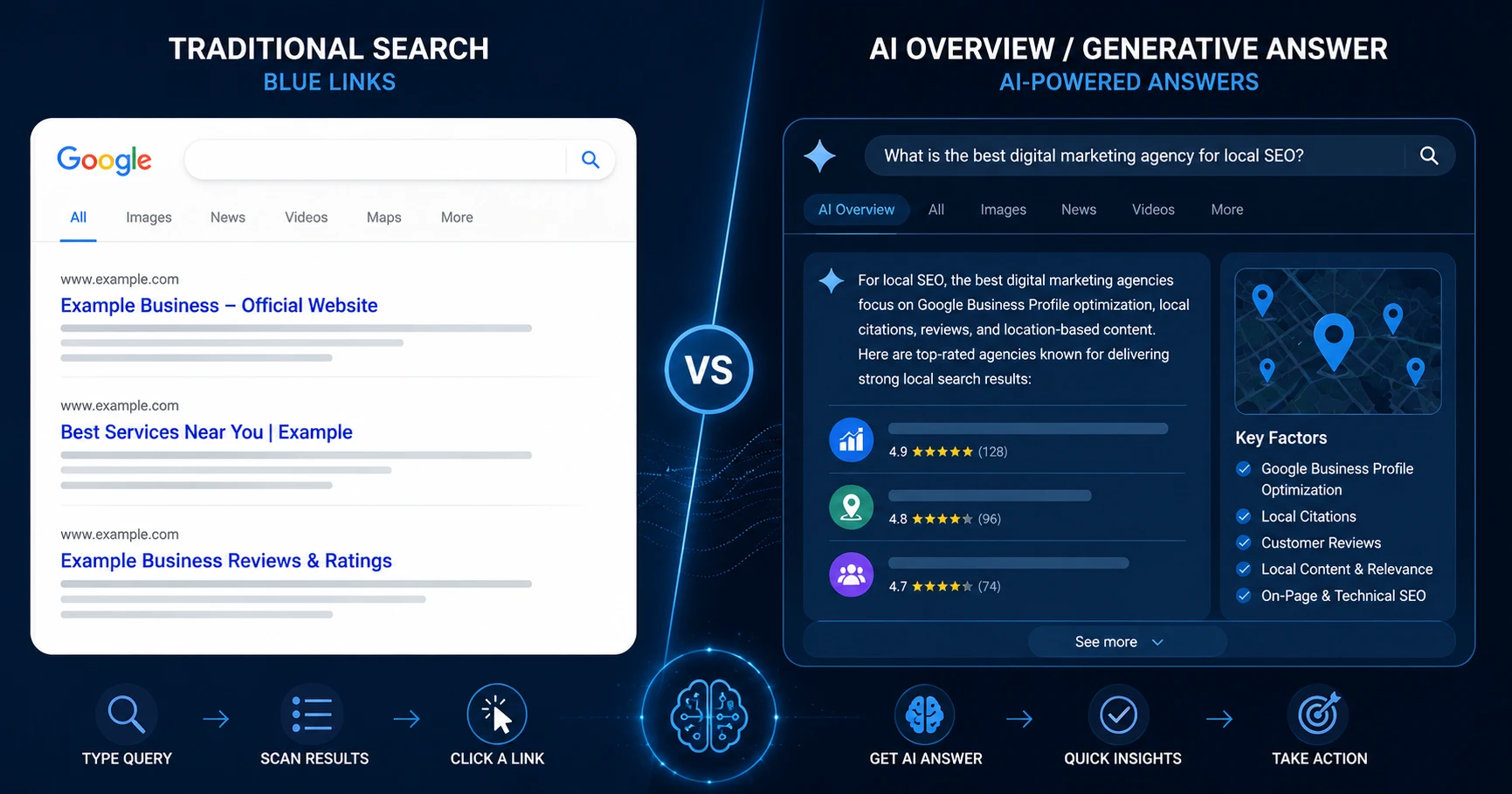
AI SEO is the practice of optimizing content to appear in both traditional Google rankings and AI-generated answers from Google AI Overviews, ChatGPT, Perplexity, and Gemini. The two tracks require different signals: traditional SEO rewards rankings and backlinks; AI in SEO rewards structured content, E-E-A-T authority, answer-first formatting, and consistent entity presence across the web. In 2026, both tracks must be optimized simultaneously.
Introduction
62% of brands investing heavily in traditional SEO are completely invisible to generative AI models. When AI is asked unbranded questions about their core services, those brands fail to appear in 81% of test cases (Navoto 2026 industry audit of 1,000 enterprise domains).
That’s the AI SEO gap — and it’s widening. Total search volume (Google plus AI combined) has grown 26% globally in 2026. But how users interact with results has fundamentally changed. AI Overviews appear on 4.5–12.5% of all queries. ChatGPT usage for search-style queries has grown 300% year-over-year. The first interaction is no longer with a ranked webpage — it’s with a synthesized answer assembled from multiple sources.
For brands built on organic search, this creates two parallel games. Traditional SEO: rank in the blue links for high-intent queries. AI in SEO: get cited inside the AI-generated answers that now appear above those links. Winning in 2026 requires playing both simultaneously — with different tactics, different content structures, and different success metrics for each.
This guide covers the complete AI SEO framework: what changed, what stayed the same, how to optimize for AI citation, and how to measure visibility across both search surfaces.
5 KEY TAKEAWAYS
- AI SEO has split into two parallel tracks — traditional ranking (still essential) and AI citation optimization (new and growing). Both must be pursued simultaneously.
- Only 38% of pages cited in AI Overviews also rank in the top 10 of traditional search — AI citation and traditional ranking are no longer the same game.
- Google confirmed that its generative AI features use the same core ranking systems as traditional search — meaning strong SEO foundations directly support AI visibility.
- E-E-A-T is no longer just a ranking factor — it is the primary signal AI systems use to determine which sources to cite. Anonymous content is structurally disadvantaged.
- Answer-first content structure — a direct 40–60 word answer immediately below each H2 — is the single highest-impact change for AI citation readiness.
What AI SEO Actually Means in 2026
AI SEO is not a replacement for traditional SEO. It is an extension of it — one that requires the same technical foundations (indexation, Core Web Vitals, structured data) but adds a new optimization layer targeting AI extraction and citation.
Google’s official guidance, updated May 2026, confirms this directly: generative AI features on Google Search use the same core ranking and quality systems as traditional search. They rely on retrieval-augmented generation (RAG) — pulling content from Google’s existing index based on established relevance signals. Strong traditional SEO is the prerequisite for AI visibility, not a separate system.
What AI in SEO adds is a content structure requirement. AI systems extract answer-ready content from indexed pages. Pages that bury answers in narrative prose, lack clear H2/H3 hierarchy, or contain no structured FAQ or definition blocks are less likely to be extracted even when they rank strongly in traditional results.
| Signal Type | Traditional SEO | AI SEO (Citation Optimization) |
|---|---|---|
| Primary objective | Rank in top 10 blue links | Be cited inside AI-generated answers |
| Content structure | Narrative prose with headings | Answer-first paragraphs, structured Q&A, definition blocks |
| Authority signal | Backlinks and domain authority | E-E-A-T: named authors, credentials, original research |
| Keywords | Target query match | Semantic entities and topic coverage |
| Measurement | GSC clicks, impressions, position | AI citation frequency, Share of Voice in AI responses |
| Technical base | Indexation, speed, CWV | Same — plus FAQ schema, Speakable schema, structured data |
The AI Search Landscape: What Has Changed
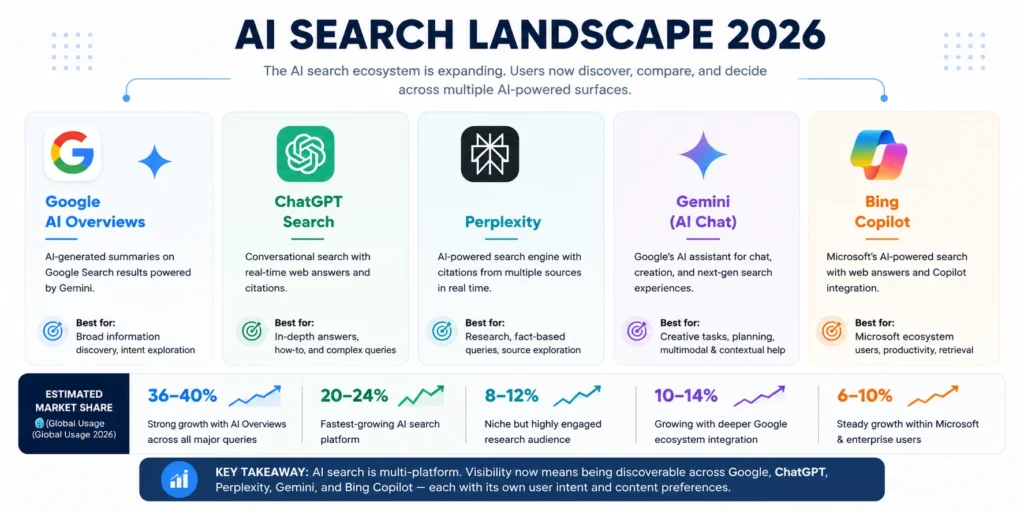
Four AI search surfaces now require consideration in any AI SEO strategy. Each uses different source selection criteria and produces different citation patterns.
| Platform | How It Sources Content | Key Citation Signal | Traffic Impact |
|---|---|---|---|
| Google AI Overviews | RAG from Google’s index — same ranking systems | Strong traditional SEO + structured content + E-E-A-T | CTR drop of 61% on affected queries; citations earn +35% clicks |
| ChatGPT Search | Bing index + web browsing | Recent publication, authoritative backlink profile, structured data | Growing fast; 300% YoY query growth; high-intent users |
| Perplexity | Real-time web search + curated sources | Clear source attribution, structured content, E-E-A-T | Smaller volume; high citation transparency — good for measuring AI visibility |
| Gemini / Bard | Google index + Google products | Strong GBP, Google-ecosystem presence, structured entities | Dominant for local and commerce queries in 2026 |
The practical implication: optimizing for Google AI Overviews and Gemini largely overlaps with traditional Google SEO. Optimizing for ChatGPT and Perplexity requires attention to Bing indexation, recent publication dates, and strong off-page citation signals (brand mentions across the web, not just backlinks). A complete AI SEO program addresses all four surfaces.
As AI Overviews increasingly suppress organic clicks, SEO teams must also diagnose and fix CTR leaks caused by AI Overview suppression by learning how to improve CTR using GSC, using query-level data from Google Search Console to identify affected pages and optimize click performance.
How to Optimize Content for AI Citation
The content structure changes that produce AI citations are well-documented in 2026. They are not algorithmic hacks — they are readability improvements that make content easier for AI extraction systems to parse, understand, and attribute.
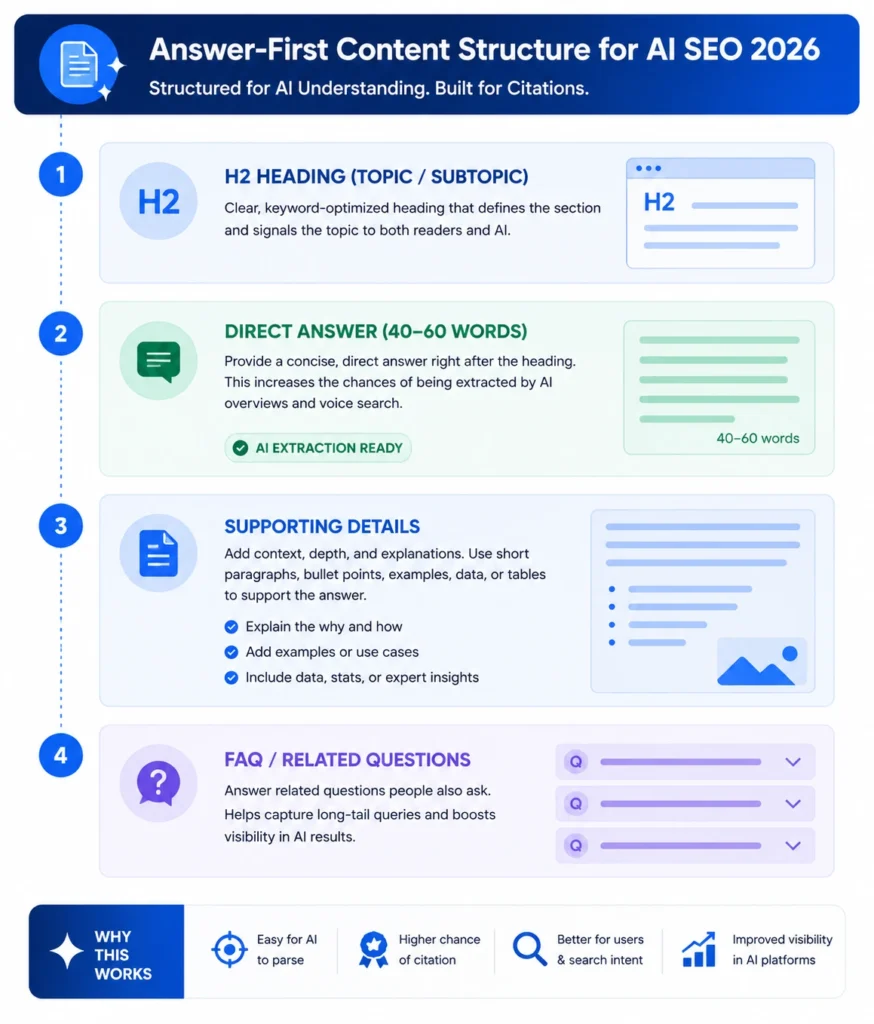
Answer-First Paragraphs
The single highest-impact change for AI citation readiness is adding a 40–60 word direct-answer paragraph immediately below each H2 heading. This paragraph should answer the subheading as a standalone question — not introduce what the section will discuss.
55% of AI Overview citations come from the top 30% of a page. If the answer appears after the third subheading or requires reading three paragraphs of context first, it will not be extracted. The answer must be the first sentence of each section — everything that follows is supporting detail for readers who want depth.
- Write the first paragraph of every H2 section as if it will be read in isolation — no references to ‘as mentioned above’ or ‘as we’ll cover later’
- Keep each answer paragraph under 75 words — AI systems extract the shortest complete answer available, not the most detailed one
- State the answer first, then qualify it — not ‘there are several factors, including X’ but ‘X is the primary factor, because Y and Z’
Structured Data for AI Extraction
FAQ schema, Speakable schema, and LocalBusiness schema all increase the likelihood that AI systems will extract and attribute content from a page. Google explicitly confirmed that Speakable schema helps its AI systems identify content suitable for voice and AI-generated response formats.
- FAQ schema: implement on every informational page targeting question-format queries — generates People Also Ask entries and increases AIO citation likelihood
- Speakable schema: marks specific paragraphs as AI-readable answer content — particularly effective for definition and how-to content
- HowTo schema: for step-by-step content, marks each step individually — AI systems extract step-format content at high rates
E-E-A-T Signals for AI Citation
AI systems — including Google’s RAG-based AI Overviews — weight source authority heavily. Pages with expert authorship are 3.2x more likely to be cited in AI Overviews than anonymously published content. E-E-A-T is no longer a quality signal that helps rankings — it’s the primary filter AI systems apply to source selection.
- Named author attribution on every piece of content — name, credentials, and a link to an author bio page
- First-hand experience signals: specific examples, named clients, original case studies, proprietary data — AI systems evaluate whether content demonstrates genuine expertise or summarizes other sources
- Last-updated dates: ChatGPT cited 76.4% of pages updated within the last 30 days (Otterly.AI 2026). Freshness is a citation factor for AI systems in a way it never was for traditional rankings
Brand citations across the web: mentions of your brand name in third-party content — news articles, industry publications, directories — strengthen entity recognition across all AI platforms
AI SEO vs Traditional SEO: What Stays, What Changes
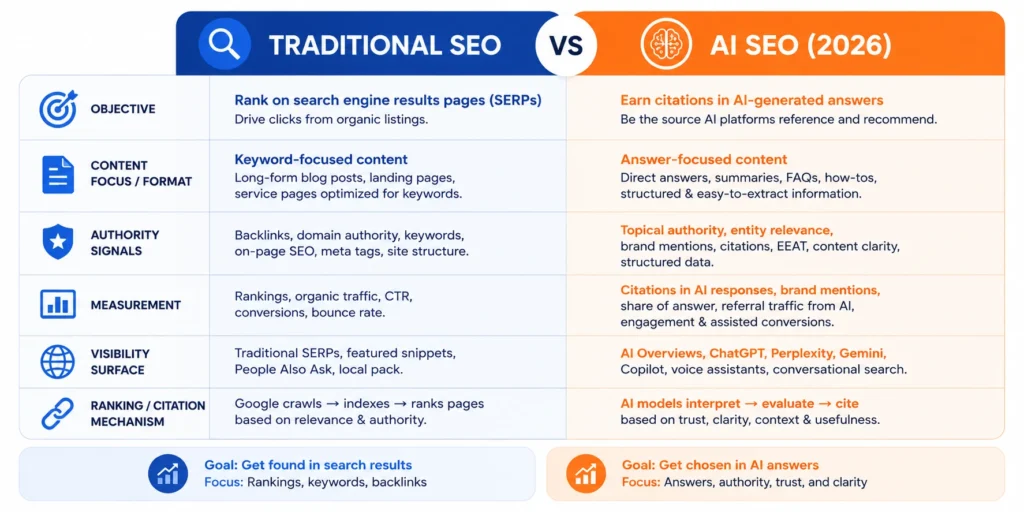
Google’s explicit guidance (May 2026) is the clearest statement available: ‘The best practices for SEO continue to be relevant because our generative AI features are rooted in our core Search ranking and quality systems.’ This means every traditional SEO investment — technical health, backlinks, content quality, Core Web Vitals — directly supports AI visibility.
What changes is the content optimization layer. Traditional SEO optimizes for the click. AI SEO optimizes for extraction before the click. The additional work is not a replacement — it’s a structural layer added on top of an already-sound SEO foundation.
What Google Says NOT to Do for AI SEO
Google’s official AI optimization guide explicitly warns against several tactics circulating in the SEO community in 2026:
‘Chunking’ content into artificially short paragraphs specifically to optimize for AI extraction
Creating llms.txt files — Google states this has no impact on its AI systems
Pursuing ‘inauthentic mentions’ — paying for brand mentions specifically to game AI citation
AEO/GEO hacks that treat AI optimization as a separate system disconnected from core SEO quality signals
Google’s guidance: optimize for users and maintain strong traditional SEO foundations. The same signals work for both surfaces.
Measuring AI SEO Visibility
AI citation visibility is not measurable in Google Search Console. GSC tracks traditional SERP clicks and impressions — it has no native reporting on AI Overview citations, ChatGPT mentions, or Perplexity sourcing.
To bridge that gap, many teams use GSC to track traditional ranking and CTR data alongside AI visibility metrics. A detailed GSC Performance report guide can help establish the baseline organic signals that support broader AI SEO measurement within Google Search Console.
A complete AI SEO measurement stack in 2026 requires:
| Metric | Tool | What It Measures |
|---|---|---|
| Traditional rankings and CTR | Google Search Console | Standard blue-link performance; also shows AI Overview-suppressed CTR |
| AI Overview appearance | Manual SERP checks + Semrush AI Toolkit | Whether your pages appear in Google’s AI Overview panels for target queries |
| ChatGPT citation frequency | Otterly.AI or manual testing | How often your brand is cited when ChatGPT answers queries in your topic area |
| Perplexity citation visibility | Perplexity manual testing | Direct AI answer attribution — the most transparent citation surface |
| Share of Voice in AI responses | Authoritas, SE Ranking AI features | Cross-platform AI citation share vs. competitors for target query sets |
| Brand mention velocity | Google Alerts + Mention.com | Third-party web citations — a proxy for entity authority across AI systems |
The operational cadence: run traditional GSC performance analysis weekly (clicks, impressions, CTR). Run AI visibility spot-checks monthly — test 10–20 target queries in ChatGPT and Google AI Overviews in incognito. Compare which competitors appear. Identify content gaps. Update accordingly. This manual process, repeated consistently, is more actionable than any automated AI tracking tool currently available. To understand how these long-term organic gains compare with paid acquisition, read the SEO vs ads ROI guide, which compares SEO and paid performance across both traditional and emerging AI search surfaces.
The AI SEO Content Strategy: Practical Priorities
Given the overlap between traditional SEO and AI citation optimization, the most efficient AI SEO strategy is one that strengthens both simultaneously rather than running them as separate programs.
Priority 1: Audit Existing Content for AI Readiness
Before creating new content, audit existing pages ranking in positions 1–10 for target queries. These pages already have the ranking signals to appear in AI Overviews — they just need structural updates to become citation-eligible. You can find the striking distance pages most likely to earn AI citation with optimization using low-hanging keywords in GSC, then use this GSC-driven content refresh SEO guide to update those existing pages for AI readiness.
- Add answer-first paragraphs to every H2 section that currently begins with context or framing
- Add FAQ schema targeting the question-format queries from GSC’s Queries tab for each page
- Add or update author attribution with credentials and bio page links
- Add a ‘Last updated’ date and ensure it reflects genuine content changes — AI freshness filters apply
Priority 2: Build Topical Authority Clusters
AI systems evaluate topical authority at the domain level — not just page-level relevance. A site covering a topic comprehensively across a cluster of interlinked pages is more likely to be cited as an authoritative source than a site with a single strong page on the topic.
- Identify your 3–5 core topic areas where you want AI citation authority
- Map existing content against each topic cluster — identify gaps where no page exists for key sub-topics
- Create pillar pages (2,000+ words with answer-first structure) for each core topic, linked to cluster pages covering specific sub-topics
- Interlink all cluster pages — topical authority signals compound across the cluster, not just within individual pages
Priority 3: Off-Page Entity Building
AI systems like ChatGPT and Perplexity are more likely to cite brands with strong off-page entity presence — consistent mentions across multiple authoritative sources, not just backlinks. This is a distinct signal from traditional link building.
- Publish original research or data that other sites will cite — first-party data is the highest-value citation trigger
- Contribute to industry publications as a named expert author — these create authoritative off-page entity mentions
- Maintain consistent brand description language across all platforms — the same service terminology, category descriptions, and positioning language Google and AI systems use to understand your entity
Conclusion
AI SEO in 2026 is not a disruption of traditional SEO — it’s an expansion of it. The technical foundations, content quality standards, and authority-building principles that drive traditional rankings are the same ones that underpin AI citation eligibility. The gap between brands that are visible in AI-generated answers and those that aren’t is almost entirely a content structure and E-E-A-T gap, not a fundamentally different discipline.
The strategic shift is adding an optimization layer that makes strong content AI-extractable: answer-first paragraph structure, FAQ and Speakable schema, named author credentials, freshness signals, and consistent entity presence across the web. None of these require abandoning what works in traditional SEO — they require building on top of it.
The brands winning across both search surfaces in 2026 are the ones that treated AI in SEO as an additive layer early — before AI citation positions calcified around competitors who moved first. The practical starting point is your strongest existing pages: audit them for AI readiness, add answer-first structure and FAQ schema, update author attribution, and measure AI visibility monthly alongside your standard GSC review. That cycle, repeated consistently, is the complete AI SEO program.
For founders evaluating the long-term business case for this investment, see the SEO ROI guide for founders, which explains how to assess returns across both traditional and AI search.
Frequently Asked Questions
What is AI SEO?
AI SEO is the practice of optimizing content and online presence to appear in both traditional Google rankings (blue-link results) and AI-generated answers from platforms like Google AI Overviews, ChatGPT, Perplexity, and Gemini. It extends traditional SEO with structured content formatting, E-E-A-T signals, and entity consistency that make pages easier for AI systems to extract, attribute, and cite as sources in generated answers.
Does traditional SEO still work in 2026?
Yes, and it’s the prerequisite for AI SEO. Google confirmed in May 2026 that its generative AI features use the same core ranking and quality systems as traditional search. Strong traditional SEO (indexation, backlinks, content quality, Core Web Vitals) directly supports AI citation eligibility. The additional optimization for AI in SEO is a structural content layer added on top of a solid traditional SEO foundation — not a replacement for it.
How do I get cited in Google AI Overviews?
The primary factors for AI Overview citation are: ranking in traditional results for the query (AI Overviews pull primarily from Google’s index), structured content with answer-first paragraphs under each H2, FAQ and Speakable schema markup, named author credentials with verifiable expertise (E-E-A-T), original data or first-hand insights in the content, and recent publication or update dates. Pages with strong traditional rankings that add these AI citation signals typically see AIO citation within 4–8 weeks.
What is GEO (Generative Engine Optimization)?
Generative Engine Optimization (GEO) — also called Answer Engine Optimization (AEO) or LLMO — is the discipline of optimizing content to be understood, extracted, and cited by AI-powered search systems. It covers the same ground as AI SEO: structured content formatting, E-E-A-T signals, entity consistency, FAQ schema, and topical authority. Google’s official guidance warns against ‘GEO hacks’ disconnected from core SEO quality — the most effective GEO strategy is strong traditional SEO combined with structured content formatting.
How do I measure AI SEO performance?
AI citation visibility is not trackable in Google Search Console. A complete measurement approach uses: GSC for traditional ranking and CTR data (where you’ll also see AI Overview-suppressed CTR on informational queries), manual testing in ChatGPT and Perplexity for target queries monthly, Google AI Overview spot-checks in incognito for your primary keywords, tools like Otterly.AI or Authoritas for cross-platform AI citation share tracking, and brand mention monitoring via Google Alerts for off-page entity presence. Compare results quarter-over-quarter as the primary AI SEO performance metric.