
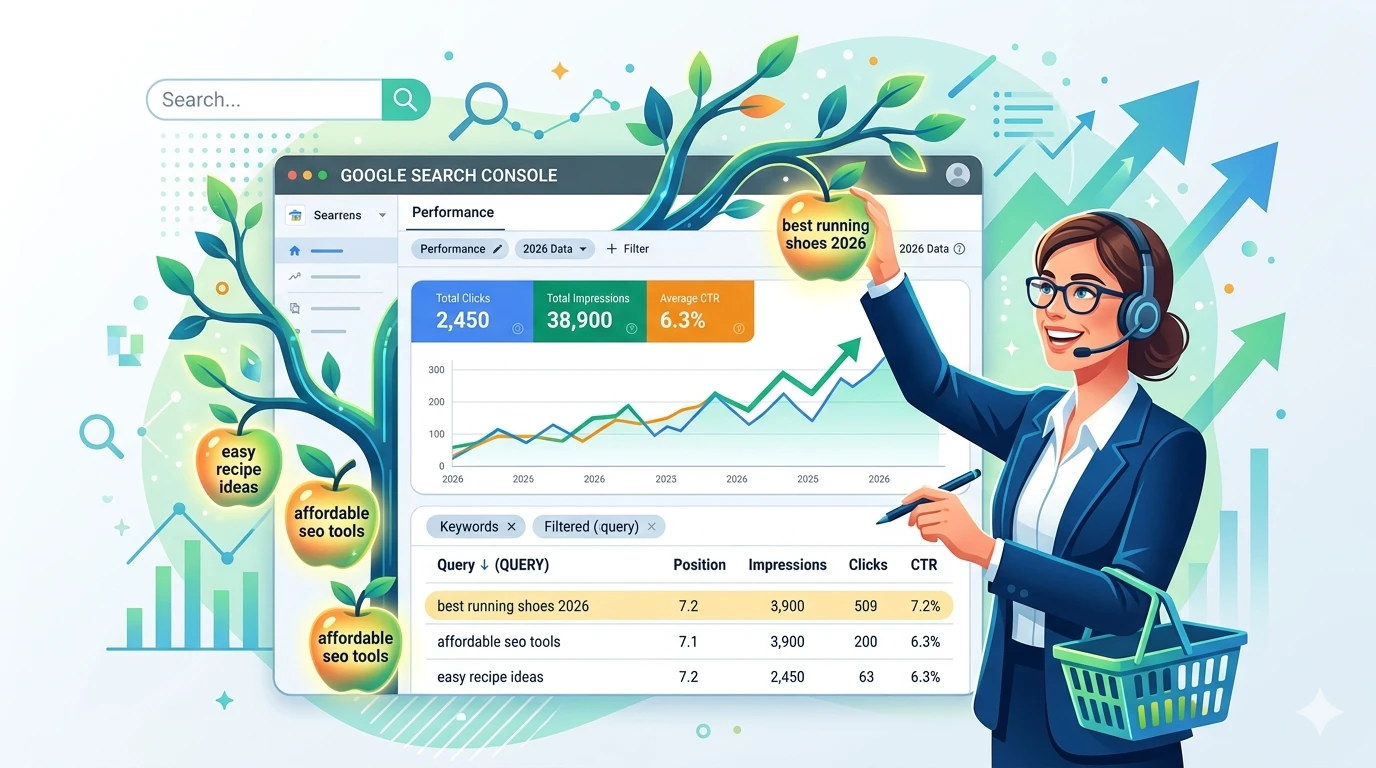
Low hanging keywords are queries your site already ranks for at positions 5–20 with decent impressions but low click-through rate. Find them in GSC by filtering the Performance report for non-branded queries at positions 5–20, then sorting by impressions. These GSC keywords require content updates or title rewrites — not new pages — to move to page one and generate measurable traffic gains in 30–60 days.
Introduction
New keyword research is a slow game. Write a page, wait for Google to crawl it, wait for it to rank, wait for rankings to stabilize — that cycle takes 3–6 months before you see meaningful results.
Low hanging keywords skip all of that. These are GSC keywords your site already ranks for. The page is indexed. Google has already established an association between your content and the query. The signal exists — it just needs strengthening.
As discussed in the GSC Performance report guide GSC data patterns across mid-sized sites, pages ranking between positions 5 and 20 represent the highest-ROI optimization targets on any domain. A page moving from position 11 to position 4 can multiply clicks by 4–6x without a single new backlink. This guide shows you exactly how to find these low hanging keyword opportunities in your GSC data and the precise actions that move them.
Key Takeaways
- Low hanging keywords are queries already ranking at positions 5–20 in GSC — the page exists, the signal exists, only the optimization is missing.
- The striking distance zone (positions 5–15) delivers the fastest ROI: small content or metadata improvements can jump a page from page 2 to the top 5.
- High impressions + low CTR at positions 1–10 is a packaging problem — a title rewrite alone can double clicks without touching rankings.
- Internal links from your highest-authority indexed pages are the most underused lever for pushing low hanging keywords to page one.
- Keyword cannibalization silently suppresses low hanging keywords — two pages competing for the same query dilute each other’s ranking signal.
What Are Low Hanging Keywords — and Why GSC Is the Best Source
A low-hanging keyword is a search query where your site already ranks, but it is not getting enough traffic yet. The term comes from the SEO concept of ‘low-hanging fruit’ — wins that are close enough to reach without significant new investment.
Most keyword research tools show you keywords you don’t rank for yet — gaps to fill with new content. GSC keywords show you the opposite: queries where Google has already validated your relevance but hasn’t fully rewarded you. That distinction matters enormously for prioritization.
| Signal Type | Tool Source | Time to Traffic | Investment Required |
|---|---|---|---|
| New keyword (no ranking) | Ahrefs / Semrush | 3–6 months | New page, new links, new wait |
| Low hanging keyword (positions 5–20) | GSC — first-party data | 30–60 days | Content update or title rewrite |
| High impression / low CTR (positions 1–10) | GSC — first-party data | 7–21 days | Title tag and meta description only |
The GSC advantage over third-party tools is accuracy. Semrush and Ahrefs estimate position data from crawl samples. GSC reports actual Googlebot data — every impression, every click, every position — with no margin for estimation error. For low-hanging keyword work specifically, this matters: a position estimate of 12 from Ahrefs might be 7 in GSC. That changes the optimization priority entirely.
How to Find Low-Hanging Keywords in the GSC Performance Report
The filter workflow takes under 15 minutes. The output is a prioritized list of GSC keywords with the highest traffic recovery potential on your domain.
Step 1: Set the Correct Filters
- Open GSC → Performance → Search Results
- Set Search Type: Web (removes Image and Discover traffic)
- Enable all four metrics: Clicks, Impressions, CTR, Average Position
- Set date range: Last 3 months (smooths volatility; reflects current SERP conditions)
- Apply the native Branded filter (available since November 2025) to exclude branded queries — non-branded GSC data is where the real opportunity lives
Step 2: Export and Build the Opportunity Score
Export the filtered data to Google Sheets. In the spreadsheet, add two columns:
- Opportunity Score = Impressions × (Expected CTR for position – Actual CTR). Use 2026 position benchmarks: position 5 = ~6%, position 8 = ~3%, position 12 = ~1.5%
- Sort Opportunity Score descending — the top rows are your highest-value, low-hanging keywords
Step 3: Apply the Three-Zone Filter
| Zone | Position Range | What It Is | Primary Fix |
|---|---|---|---|
| Striking distance | 5–15 | Ranking, but not on page 1 or low on page 1 | Content depth + internal links |
| CTR leak | 1–10 with CTR under 3% | Ranking well but not getting clicked | Title tag + meta description rewrite |
| Recovery zone | 16–30 | Ranking on page 2–3 with impressions | Full content refresh + link building |
Prioritize striking distance keywords first — the optimization effort is smallest and the traffic gain is fastest. CTR leaks require only metadata changes and can show results within 7–21 days of Google recrawling the page. Recovery zone keywords need more structural work and a longer timeline.
What to Do with Low Hanging Keywords: Three Optimization Paths
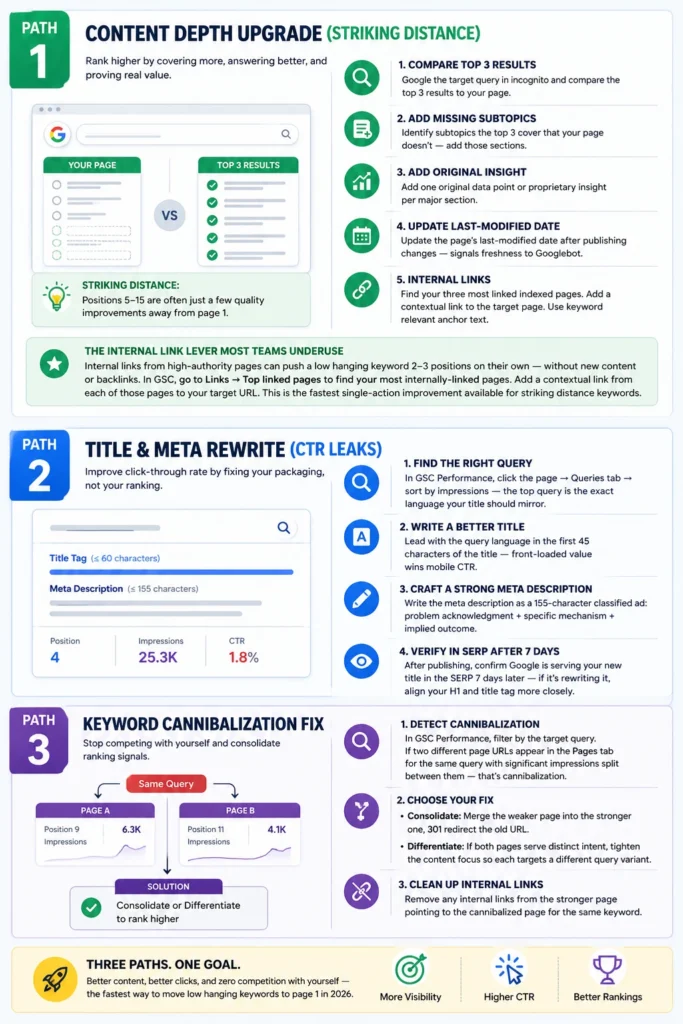
Path 1: Content Depth Upgrade (Striking Distance)
Pages in positions 5–15 are often outranked by pages that cover more subtopics. They also answer follow-up questions. They may include data and examples that increase dwell time. Google the target query in incognito and compare the top 3 results to your page.
Once gaps are identified, follow a structured process for how to refresh content using GSC to expand coverage, improve depth, and reclaim rankings systematically.
- Identify subtopics the top 3 cover that your page doesn’t — add those sections
- Add one original data point or proprietary insight per major section
- Update the page’s last-modified date after publishing changes — signals freshness to Googlebot
- Internal links: Find your three most linked indexed pages. Add a contextual link to the target page. Use keyword relevant anchor text
Internal links from high-authority pages can push a low-hanging keyword 2–3 positions on their own — without new content or backlinks. In GSC, go to Links → Top linked pages to find your most internally-linked pages. Add a contextual link from each of those pages to your target URL. This is the fastest single-action improvement available for striking distance keywords.
Path 2: Title and Meta Rewrite (CTR Leaks)
For pages ranking in positions 1–10 with CTR below 3%, the ranking signal is strong — the packaging is weak. The fix is metadata, not content.
- In GSC Performance, click the page → Queries tab → sort by impressions — the top query is the exact language your title should mirror
- Lead with the query language in the first 45 characters of the title — front-loaded value wins mobile CTR. Know how to improve CTR using GSC for full CTR diagnosis framework before rewriting any metadata
- Write the meta description as a 155-character classified ad: problem acknowledgment + specific mechanism + implied outcome
- After publishing, confirm Google is serving your new title in the SERP 7 days later — if it’s rewriting it, align your H1 and title tag more closely
Path 3: Keyword Cannibalization Fix
Two pages competing for the same low-hanging keyword dilute each other’s ranking signal. This is the silent suppressor that keeps pages stuck at positions 8–12 despite good content.
How to detect it: in GSC Performance, filter by the target query. If two different page URLs appear in the Pages tab for the same query with significant impressions split between them — that’s cannibalization.
- Consolidate: merge the weaker page into the stronger one, 301 redirect the old URL
- Differentiate: if both pages serve distinct intent, tighten the content focus so each targets a different query variant
- Internal link: remove any internal links from the stronger page pointing to the cannibalized page for the same keyword
Finding Semantic and Long-Tail Variations Inside Your GSC Keyword Data
Low-hanging keywords often cluster around a single head term. Inside GSC, each high-impression query includes long-tail and semantic variants in the same data. These queries have lower volume and near-zero competition. Your page can rank for them with minimal extra work.
In the Performance report, filter by a specific page URL, then open the Queries tab. Sort by impressions. The top 10–15 queries for that page represent a semantic cluster — related phrases Google is already associating with your content. These are your next-tier GSC keywords.
- Queries your page ranks for in positions 15–30 with 50+ impressions are long-tail, low-hanging keywords. Add a targeted section or FAQ that directly answers the query
- Question-format queries (how, what, why) in the list are FAQ schema candidates — structured data can generate People Also Ask appearances and additional impression volume
- Location modifier variants (e.g. ‘for small business’, ‘in 2026’, ‘without tools’) appearing in the query list indicate subtopics the page doesn’t yet cover explicitly
Export the query list for your top 5 striking distance pages. In Google Sheets, filter for queries with positions 15–30 and impressions above 50. Group by semantic theme (question variants, modifier variants, location variants). Each group is a candidate section to add to the existing page — not a new page to create. This expands topical coverage while strengthening the same URL’s authority signal.
How to Prioritize Low-Hanging Keywords for Maximum Impact
Not every low-hanging keyword is worth optimizing. The highest-priority targets share four characteristics:
| Criteria | What to Check | Minimum Threshold |
|---|---|---|
| Impressions | Query impressions in the last 3 months | 50+ impressions (below this, traffic ceiling too low) |
| Position | Current average position | 5–20 for striking distance; 1–10 for CTR leaks |
| Business relevance | Does ranking here support a conversion goal? | High vanity traffic from irrelevant queries wastes optimization time |
| SERP feasibility | Are the top 3 results from sites with higher authority than yours? | Avoid if top 3 are all DA 80+ with exact-match topics |
| Intent alignment | Does the query’s dominant SERP format match your page? | Must match — a listicle SERP requires a list format, not a guide |
Apply this scoring to your exported GSC keyword list. Queries meeting all five criteria are Tier 1 — act on these first. Queries meeting three or four are Tier 2 — schedule for the following sprint. Anything below three criteria is deprioritized regardless of impression volume.
Conclusion
The best ROI keyword work on an established site is not finding new queries. It is winning back traffic from easy keywords Google already links to your pages. The evidence is in your GSC data. Every query ranking in positions 5–20 with strong impressions is a traffic opportunity. Your domain has already earned the right to pursue it.
The sites that compound organic growth are the ones treating this as a recurring workflow — not a one-time exercise. A structured GSC opportunities audit guide can help you run a weekly GSC audit to catch low-hanging keywords automatically and turn ranking gains into repeatable traffic growth.
Run this audit monthly. GSC data is kept for only 16 months. Keyword opportunities can change as competitors update content. Algorithm updates can shift rankings. New long-tail queries can also appear in your niche. The sites that compound organic growth are the ones treating this as a recurring workflow — not a one-time exercise.
Frequently Asked Questions
What are low hanging keywords in SEO?
Low hanging keywords are search queries your site already ranks for — typically at positions 5–20 — but is not yet fully capitalizing on due to weak CTR, thin content, or poor internal linking. Unlike new keyword targets that require months of content creation and link building, low hanging keywords can generate measurable traffic gains in 30–60 days because Google has already established relevance between your page and the query.
How do I find low-hanging keywords in Google Search Console?
In GSC Performance, set Search Type to Web, apply the branded queries filter to exclude brand traffic, and filter for positions 5–20 over the last 3 months. Export to Sheets, then add an Opportunity Score column: Impressions × (Expected CTR for that position – Actual CTR). Sort descending. The top results are your highest-priority low hanging keywords. Also check for high-impression queries at positions 1–10 with CTR below 3% — these are CTR leak opportunities requiring only a title rewrite.
What is the difference between low-hanging keywords and striking distance keywords?
Striking distance keywords are a specific subset of low-hanging keywords — queries ranking between positions 5–15 that are close to the top of page one. Low hanging keywords is the broader category that includes striking distance (positions 5–15), CTR leaks (positions 1–10 with low CTR), and recovery zone keywords (positions 16–30). Each requires a different optimization approach. Striking distance typically needs content depth and internal links. CTR leaks need metadata rewrites. Recovery zone keywords need more comprehensive content updates.
How many impressions does a keyword need to be worth optimizing?
As a general rule, any query with 50 or more impressions in the last 3 months is worth evaluating. Below that threshold, the traffic ceiling — even at position 1 — is too low to justify the optimization effort unless the keyword has extremely high commercial intent relevant to your business. Above 200 impressions at a striking distance position, the opportunity score is almost always high enough to prioritize.
Can low hanging keywords help with AI Overview visibility?
Yes — indirectly. Optimizing low hanging keywords typically involves improving content depth, adding structured FAQ sections, and strengthening E-E-A-T signals. These are the same factors Google uses to select AI Overview citation sources. A page that moves from position 12 to position 4 for a query with an AI Overview is also a stronger citation candidate — because 55% of AI Overview citations come from the top 30% of a page’s content and from pages with higher organic rankings for the same query.