
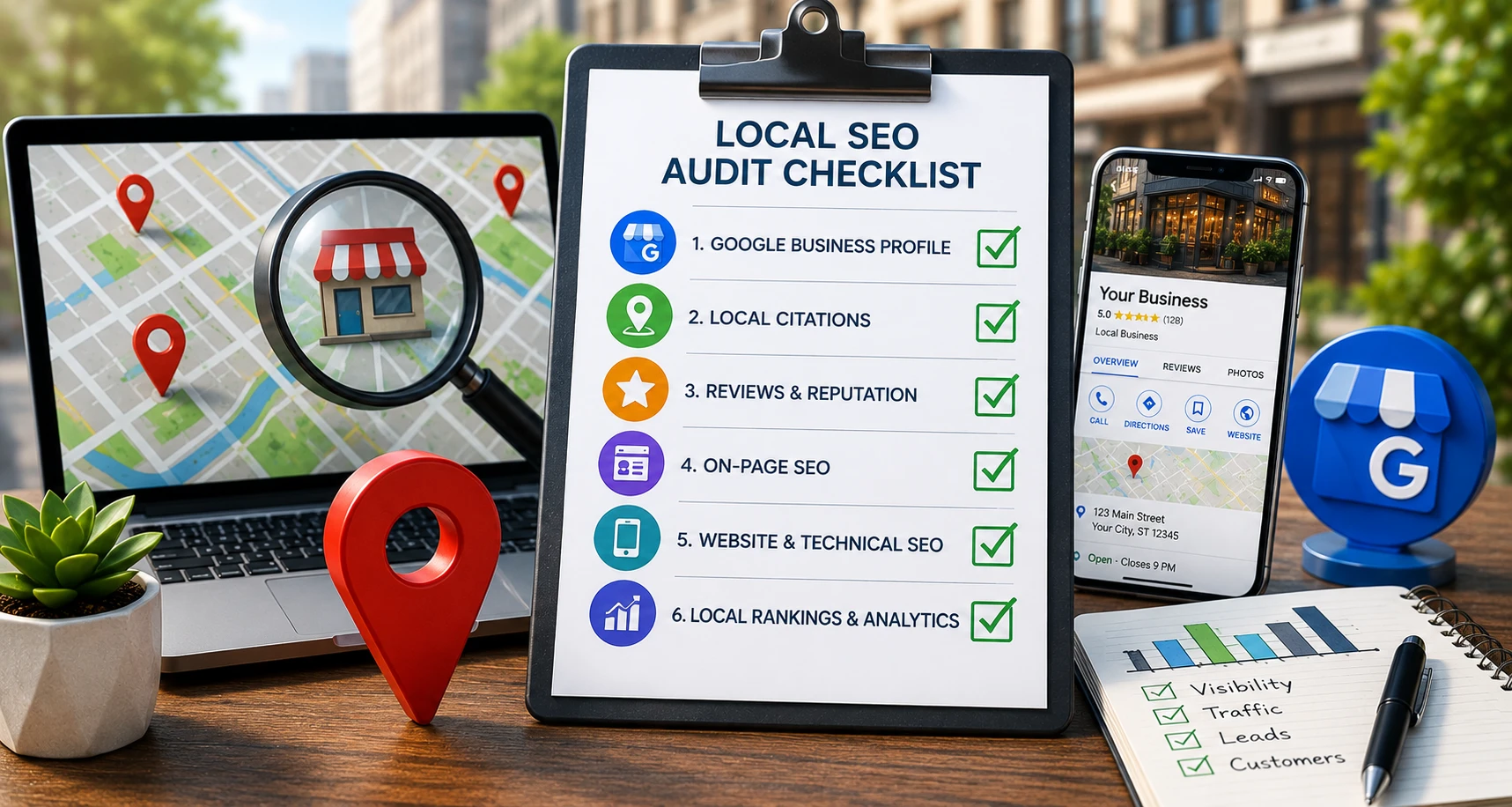
A local SEO audit evaluates six areas: Google Business Profile accuracy, NAP and citation consistency, on-page local signals, technical SEO, review profile health, and AI search visibility. Run this SEO checklist quarterly to identify ranking gaps before competitors exploit them. Fix any issue preventing customers from reaching you first — wrong contact details, broken pages, or incorrect GBP data — before any optimization work begins.
Introduction
Local visibility degrades silently. Rankings drop gradually as competitors update their profiles, reviews go unanswered, citations drift out of sync, and location pages stop matching what the SERP now rewards. By the time traffic falls enough to trigger concern, the problem has been compounding for months.
A structured local SEO audit stops that drift. It identifies the specific gaps — in your GBP, website, citations, reviews, and technical setup — before they compound into ranking losses. The businesses that maintain consistent local pack visibility run this SEO checklist quarterly, not reactively. For the broader framework behind these checks, review the local SEO guide for business and understand the full local SEO strategy this audit supports.
In 2026, a local SEO audit must now cover a seventh consideration that didn’t exist in previous versions of this process: AI search visibility. ChatGPT usage for local business recommendations grew from 6% to 45% in one year (BrightLocal 2026). An audit that doesn’t check AI visibility is missing the fastest-growing local discovery channel.
This checklist covers all six areas in priority order — the sequence that fixes the highest-impact issues before investing time in lower-weight optimizations.
5 KEY TAKEAWAYS
- Always fix issues that prevent customers from reaching you first — wrong address, broken contact forms, or inactive phone numbers — before any other audit work.
- NAP consistency across your GBP, website, and citations is the foundation of local entity trust — inconsistencies suppress rankings across all other factors.
- The GSC Performance report and GBP Insights together provide the data for a complete local SEO audit — most findings can be made without paid tools.
- Review velocity is more important than review count in 2026 — a stale review profile (no reviews in 90+ days) is an active ranking suppressor, not a neutral signal.
- AI search visibility is now a measurable audit category — test your business in ChatGPT and Perplexity before considering your audit complete.
Before You Start: The Pre-Audit Setup
A local SEO audit without a baseline produces findings with no way to measure progress. Two setup steps before running any audit item:
- Define your primary goal: calls, bookings, walk-in traffic, or form submissions. The goal determines which audit findings get prioritized — a business with no call tracking cannot measure whether a GBP fix improved call volume
- Document your current metrics: GBP discovery impressions, GBP customer actions (calls, directions, website clicks), local pack position for 3–5 primary keywords, review count and average rating, and organic traffic to location pages from GSC. Record these before touching anything — they’re your before-state for the quarterly comparison
🛠 Tools Required for This SEO Checklist
- Google Search Console — indexation, performance, Core Web Vitals
- GBP Insights dashboard — discovery impressions, customer actions, photo views
- Google Analytics 4 — location page traffic, conversion events, source attribution
- BrightLocal or Whitespark — citation audit and local rank tracking (geo-grid)
- Screaming Frog (free tier, 500 URLs) — technical crawl, broken links, title and meta audit
1. Google Business Profile Audit
GBP signals account for 32% of local pack ranking weight (Whitespark 2026). To understand the complete weighting model, review local SEO ranking factors 2026 and see why GBP remains the most influential controllable local ranking signal. Eight of the top ten local pack signals come directly from GBP. This is the highest-impact area of any local SEO audit.
Core Information
- Business name matches legal trading name exactly — no keyword additions, city names, or service descriptors
- Primary category is the most specific accurate option for your core revenue service — not a broad parent category
- Secondary categories are added only for services actively offered
- Address (if displayed) matches GBP, website footer, and all citations exactly — including street abbreviations and suite formatting
- Phone number uses a local area code and matches all citation sources
- Website URL links to a dedicated location page, not the homepage
- Business hours are current — including special hours for upcoming holidays
After identifying gaps, follow the Google Business Profile optimization SOP to systematically fix every issue and strengthen local ranking signals.
Content Completeness
- Business description uses all 750 characters — starts with primary service and location in the first sentence
- Services section lists every service with descriptions — not bundled into a single generic entry
- Attributes section completed for all applicable options (accessibility, payment methods, service options)
- Products section completed for product-based businesses with pricing
Visual and Engagement Content
- Minimum 15–20 photos covering exterior, interior, team, services in action
- At least one video uploaded (up to 60 seconds)
- New photos added within the last 30 days — freshness is a minor but measurable signal
- Q&A section: 5–7 seed questions answered, recent questions monitored and responded to
- GBP messaging enabled only if responses can be guaranteed within 24 hours
2. NAP Consistency and Citation Audit
NAP (Name, Address, Phone) consistency is the trust foundation Google uses to verify business legitimacy. Inconsistencies across platforms create entity ambiguity that suppresses local rankings. AI systems also cross-reference business data across sources — inconsistent NAP reduces AI recommendation likelihood.
Core Citation Audit
- Run a citation audit using BrightLocal or Whitespark — export every listing found for your business
- Flag any inconsistencies in business name format, address (including abbreviations), phone format, or website URL
- Priority platforms to verify and complete: Google Business Profile, Apple Maps, Bing Places, Yelp, Facebook, and any industry-specific directories
- Check for duplicate GBP listings — multiple listings for the same location with conflicting information are a common silent ranking suppressor
Website NAP
- NAP appears in the website footer on every page — formatted identically to GBP
- Contact page includes: full address, phone, hours, and an embedded Google Map
- LocalBusiness schema markup is implemented with name, address, phone, opening hours — verify with Google’s Rich Results Test
3. On-Page Local SEO Audit
On-page signals account for 19% of local pack ranking weight. The website amplifies and validates the relevance signals established by GBP — they must tell the same story about what you do and where you do it.
Location Pages
- Each physical location has a dedicated landing page with full NAP, services at that location, and genuine local content
- For service-area businesses: city-specific pages exist for each primary service area with unique content (not templated copy with only the city name swapped)
- GBP links to the correct location page — not the homepage
- Location pages include local neighborhood references, staff photos, and location-specific FAQs
Service Pages
- Individual pages exist for each primary service — not a single bundled ‘services’ page covering everything
- Service pages include local keywords naturally (service + city) in title tag, H1, and first paragraph
- Each service page has a clear call-to-action — phone number, booking link, or contact form visible above the fold
Title Tags and Meta Descriptions
- Title tags for location and service pages follow the format: [Service] in [City] — [Business Name]
- Meta descriptions are written as conversion copy — not keyword summaries
- No duplicate title tags across location or service pages
4. Technical SEO Audit
Technical issues don’t create local rankings — but they prevent them. Crawl errors, slow load times, and mobile usability failures suppress the effect of every other optimization in this SEO checklist.
Indexation
- Run URL Inspection in GSC for all primary location and service pages — confirm they are indexed
- Check GSC Coverage report for any Errors or “Crawled — not indexed” status on priority pages. Use a GSC Coverage report guide to understand every Coverage report status before auditing indexation.
- Check GSC Coverage report for any Errors or ‘Crawled — not indexed’ status on priority pages
- XML sitemap includes all location and service pages — no 404 or noindex pages in the sitemap
Performance and Mobile
- Core Web Vitals: check GSC’s Experience report for any pages with Poor LCP, CLS, or INP scores
- Mobile usability: GSC’s Mobile Usability report shows any pages with mobile rendering issues
- PageSpeed: location pages load in under 3 seconds on mobile — test with Google PageSpeed Insights
- Click-to-call: phone numbers are tap-to-call on mobile — test on a real device
After validating technical health, use a GSC Performance report guide to audit location page click and impression data and identify whether technical improvements are translating into organic visibility gains.
Technical Checks
- HTTPS active across all pages — no mixed content warnings
- No broken internal links from location or service pages — run Screaming Frog crawl
- Canonical tags are correctly implemented — location pages self-canonicalize, not pointing to the homepage
5. Review Profile Audit
Review signals account for approximately 20% of local pack ranking weight in 2026 — up from 16% in 2023. The review profile audit assesses both ranking signals and conversion signals, since 87% of consumers read reviews before choosing a local business (BrightLocal 2026).
Review Health Metrics
- Current average rating: 4.0 stars minimum to avoid a measurable conversion penalty; 4.5 is the target
- Review recency: at least one new review in the last 30 days — a gap of 90+ days is an active ranking suppressor
- Review velocity trend: is the weekly/monthly rate increasing, stable, or declining? Declining velocity requires an operational fix, not just an outreach push
- Response rate: 80%+ of reviews responded to. Check for unanswered reviews more than 7 days old
- Review distribution: verify no single star rating dominates — a natural distribution signals authenticity to Google’s review quality filters
Review Platform Coverage
- Claim and monitor reviews on: Google, Yelp, Facebook, and any industry-specific platforms (Healthgrades for healthcare, Avvo for legal, Houzz for home services)
- Google reviews receive the most ranking weight — any review acquisition effort should prioritize GBP first
6. AI Search Visibility Audit
AI search visibility became a formal local SEO ranking category for the first time in Whitespark’s 2026 survey. ChatGPT usage for local recommendations grew from 6% to 45% in one year. AI systems that cannot clearly understand your business entity will not recommend you — regardless of your traditional SEO performance.
AI Visibility Test
- Open ChatGPT and search: ‘Who is the best [your service] in [your city]?’ — note which businesses are mentioned and whether yours appears
- Repeat with Perplexity and Google AI Overview — the results differ across systems
- If competitors appear but your business doesn’t: entity clarity and citation consistency are the primary gaps to fix
AI Readiness Signals
- Business entity is described consistently across GBP, website, and all citation sources using the same service terminology
- FAQ schema implemented on location and service pages — AI systems extract structured Q&A content
- Review content uses natural language mentioning specific services — generic short reviews contribute less to AI citation signals than detailed ones
- Business is mentioned beyond its own website — local news coverage, community mentions, and industry directory listings improve AI entity recognition
Audit Prioritization: What to Fix First
A complete local SEO audit surfaces more findings than can be actioned simultaneously. Use this priority framework to sequence fixes correctly:
| Priority | Fix Category | Examples | Timeline |
|---|---|---|---|
| P1 — Immediate | Customer-blocking issues | Wrong phone, broken contact form, incorrect address, closed GBP listing | Fix before anything else — same day |
| P2 — This Week | GBP accuracy issues | Wrong primary category, incomplete services, outdated hours, missing NAP | 1–2 weeks — rankings shift within days of category changes |
| P3 — This Month | Citation inconsistencies and on-page gaps | NAP mismatches across directories, missing location pages, no LocalBusiness schema | 3–4 weeks — category correction first, then citation cleanup |
| P4 — This Quarter | Review velocity, technical SEO, AI visibility | Declining review rate, slow location pages, no AI search presence | Ongoing — these compound over time rather than delivering single fixes |
The Quarterly Audit Cadence
Run this local SEO audit quarterly — not annually. Local search changes faster than annual reviews can capture: competitors update their profiles, algorithm updates redistribute ranking weight, and review profiles decay without a consistent acquisition system in place.
After each audit, compare against the pre-audit baseline metrics you documented. GBP discovery impressions trending up confirms relevance signals are improving. Local pack position improvement confirms ranking signals are compounding. Customer actions (calls, directions, website clicks) increasing confirms the audit fixes are converting into real business outcomes — not just technical compliance.
Conclusion
A local SEO audit is not a one-time exercise. It’s a diagnostic system that runs quarterly to catch the drift that silently erodes local rankings between major optimization efforts. Most local businesses losing map pack positions aren’t losing them to a single dramatic change — they’re losing them to competitors who are running this SEO checklist consistently while the affected business assumes everything is fine.
The six audit areas in this checklist are sequenced by impact weight, not alphabetical order. Fix GBP issues first — they carry 32% of local ranking weight. Then citations and NAP, then on-page signals, then technical SEO, then reviews, then AI visibility. Running them in this sequence ensures the highest-impact corrections happen before lower-priority work consumes time and attention.
Local search in 2026 rewards businesses that maintain consistent, accurate, and active presence across every signal Google and AI systems read. This checklist makes that maintenance systematic — and systematic maintenance is what separates sustained local pack visibility from the cycle of optimization-and-decay that most local businesses experience.
Frequently Asked Questions
What is a local SEO audit?
A local SEO audit is a systematic evaluation of your business’s online presence across the signals that determine local search rankings. It covers Google Business Profile accuracy, NAP consistency across citations, on-page local content, technical SEO health, review profile strength, and AI search visibility. The goal is to identify specific gaps that are suppressing local pack rankings or preventing the business from appearing in Google Maps results — and to prioritize fixes by their impact on ranking weight.
How often should I run a local SEO audit?
Quarterly. Local search changes faster than annual audits can catch — competitors update their profiles, algorithm updates shift ranking weights, and review profiles decay without consistent maintenance. A quarterly cadence also provides four before/after data points per year, building a historical view of performance trends that a single annual audit cannot produce. Between audits, monitor GBP discovery impressions and review velocity weekly as leading indicators that a full audit may be needed sooner.
What tools do I need for a local SEO audit?
The core stack: Google Search Console (indexation, performance, Core Web Vitals — free), GBP Insights dashboard (discovery impressions, customer actions — free), Google Analytics 4 (location page traffic and conversions — free), and a citation audit tool such as BrightLocal or Whitespark (paid, but a single quarterly run is sufficient). Screaming Frog’s free tier (500 URLs) covers the technical crawl for most local business websites. The majority of audit findings can be surfaced without paid tools.
What is NAP consistency and why does it affect local SEO?
NAP stands for Name, Address, and Phone — the core business identity data that appears across your GBP, website, and citation directories. Google cross-references NAP data across the web to verify business legitimacy. Inconsistencies — even minor ones like ‘St.’ vs. ‘Street’ or different phone number formats — create data quality flags that suppress local rankings. In 2026, AI systems also cross-reference business entity data across multiple sources, making NAP consistency important for both traditional local pack rankings and AI search visibility.
How do I check my local SEO audit results in Google Search Console?
GSC covers the technical and on-page components of a local SEO audit. Use the Coverage report to confirm location and service pages are indexed. Use the Performance report filtered by your location pages to track clicks, impressions, CTR, and average position over time. Use the Experience report to identify Core Web Vitals failures on priority pages. Use the URL Inspection tool for individual page indexation status. Connect GSC to GA4 for the combined view of GSC performance data alongside post-click engagement and conversion data from your location pages.