
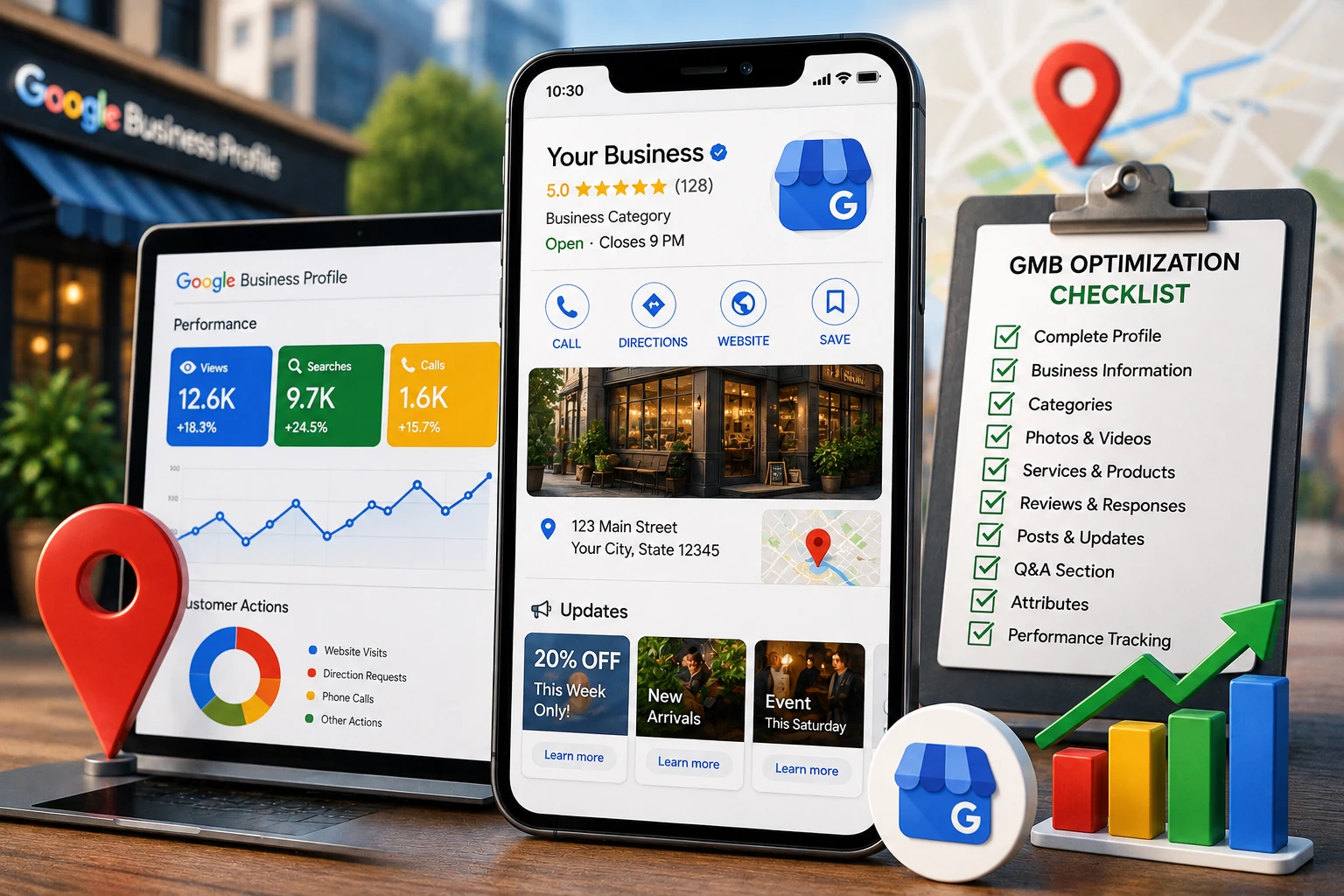
Google Business Profile (GBP) optimization is the highest-ROI GMB SEO activity for any local business. Fully completed profiles appear 18x more often in search results than basic listings. The optimization SOP covers five phases: profile setup and verification, category and NAP accuracy, content and visual completeness, review velocity management, and ongoing maintenance. Each phase builds on the previous one — skipping setup fundamentals makes all advanced optimizations less effective.
Introduction
Your Google Business Profile is your most visible local asset. For most local searches, it appears before your website — in the map pack, in Google Maps, and increasingly inside AI Overview answers. Yet 60–70% of claimed profiles are incomplete, outdated, or incorrectly configured.
The top three Google Business Profiles in any local pack capture nearly 60% of all clicks. The businesses in those positions are not there by accident — they follow a systematic GMB SEO process that covers every field, maintains consistent activity, and treats the profile as a dynamic asset rather than a one-time setup.
This SOP gives you the exact five-phase optimization process — from initial setup to weekly maintenance — in the order that produces the fastest ranking improvement and the most sustainable local pack visibility. Before implementation, review a local SEO guide for business to understand the full local SEO ranking algorithm before optimizing your GBP.
5 KEY TAKEAWAYS
- Primary GBP category is the single most influential field — an incorrect category prevents local pack visibility regardless of how optimized everything else is.
- Fully completed profiles appear 18x more in search results and receive 42% more direction requests than incomplete ones — every empty field is a missed ranking signal.
- Review velocity matters more than total count in 2026 — 4 new reviews per month consistently outperforms 50 old reviews sitting stale.
- NAP (Name, Address, Phone) must be identical across your GBP, website, and all citations — even minor formatting differences create data quality flags that suppress rankings.
- GBP optimization is a continuous SOP, not a setup task — inactive profiles lose visibility steadily, even if they were fully optimized at launch.
Phase 1: Profile Setup and Verification The trust foundation — before any optimization has effect
No GMB SEO activity produces results on an unverified profile. Verification is Google’s confirmation that your business is legitimate and located where you say it is. Skip or rush this phase, and every subsequent optimization step is built on an unstable foundation.
Claim and Verify
- Go to business.google.com → search your business name → claim if it exists, or create a new profile
- Verification options in 2026: postcard (5–7 days), phone, email, or video verification depending on business type
- Video verification is now the most common method for new profiles — record your storefront exterior, interior, and a business document in one continuous clip
- Until verified, your profile will not rank in the local pack — do not invest optimization time in an unverified listing
Access and Ownership
- Ensure the business owner holds Primary Owner access — not just Manager access
- Add a secondary owner using a non-personal email as backup — profile lockouts are the most common reason businesses lose rankings during disputes or staff changes
- Connect GBP to your Google Analytics 4 property and link to Google Search Console for post-click performance data
Phase 2: Category, NAP, and Core Fields The relevance and trust signals Google reads first
Primary Category — The Single Most Critical Decision
Your primary GBP category determines which queries your profile is eligible to rank for. A wrong primary category is the single most common reason a well-optimized profile fails to appear in the local pack. It cannot be compensated for by reviews, posts, or photos. To understand the weighting behind this, review Google local ranking factors and understand why category selection is one of the dominant local SEO ranking signals.
- Choose the most specific category available — ‘Cosmetic Dentist’ outperforms ‘Dentist’ for cosmetic queries; ‘Italian Restaurant’ outperforms ‘Restaurant’
- Cross-reference your top 3 local pack competitors — their primary categories reveal what Google rewards for your service type in your market
- Add secondary categories only for services you genuinely offer and actively want to rank for — category stuffing triggers spam filters
- Review your primary category whenever you add a new core service line
NAP Accuracy and Consistency
Name, Address, and Phone must be identical across your GBP, website footer, all citation directories, and any platform where your business appears. Inconsistencies — St. vs Street, Suite vs Ste., different area code formats — create data quality flags that suppress local rankings.
- Business name: use your exact legal trading name only. No keywords, city names, or service descriptors added — keyword-stuffed names trigger suspension under Google’s 2026 enforcement
- Address: for physical locations, confirm the address matches what Google Maps shows. For service-area businesses, remove the address and set your service area by city or region
- Phone: use a local area code where possible — toll-free numbers reduce local relevance signals
- Website URL: link to a dedicated location page, not your homepage, unless it contains full NAP and local service content. Before connecting that page to your GBP, use a GSC Coverage report guide to ensure your linked location page is indexed before connecting it to your GBP.
Business Description
Use all 750 characters. Start with your primary service and location in the first sentence. Describe who you serve, what problems you solve, and what differentiates you. Weave in one or two location-based keywords naturally.
- Avoid: subjective claims (‘best in the city’, ‘#1’), keyword stuffing, or AI-generated text that sounds generic — Google’s quality filters are more effective at detecting these in 2026
- Include: your service area, specific services offered, years in business, and any unique credentials or certifications
Phase 3: Content and Visual Completeness The prominence signals that separate listed from preferred
Services and Products
The Services section directly expands the query surface area your profile can match. Each service entry should include a name, description, and price range where applicable.
- List every service your business offers — Google’s AI uses this data to match your profile to specific search queries beyond your primary category
- Service descriptions should use the language customers actually search — not internal terminology. ‘Emergency HVAC repair’ ranks better than ‘HVAC fault resolution’
- For product-based businesses, complete the Products section with descriptions and pricing — these can appear directly in the local pack for product searches
Attributes
Attributes are the checkbox fields that describe your business characteristics — accessibility features, payment methods, service options, health and safety measures. Google’s AI analyzes these to match profiles to filtered searches like ‘wheelchair accessible dentist near me’ or ‘HVAC company that accepts credit cards.’
- Complete every attribute applicable to your business — each one expands the query types your profile can appear for
- 2026 additions: sustainability practices, service guarantees, and digital accessibility options are new attribute categories that differentiate profiles in competitive markets
Photos and Videos
Profiles with professional photos receive 35% more click-throughs and 42% more direction requests than those without. The photo set should cover every aspect of the customer experience.
- Initial upload: 15–30 photos covering exterior (from multiple approach directions), interior, team, products or services in action, before/after samples
- Cover photo and logo: high-resolution, brand-consistent — these appear prominently in search results and Maps
- Cadence: add 3–5 new photos every two weeks — profiles updating photos biweekly outperform quarterly updaters by 30% in local pack engagement
- Video: add at least one 60-second video. GBP video is still underused by most competitors — it’s an easy differentiator
Q&A Section — The Most Dangerous Neglected Feature
The Q&A section allows any Google user to ask and answer questions about your business. Left unmanaged, competitors or customers can post inaccurate answers that mislead searchers before you ever see them.
- Seed 5–7 Q&A pairs with your most common customer questions before anyone else asks
- Monitor weekly and respond to all new questions within 24 hours
- Include local keywords and service terms naturally in your answers — these are indexed by Google and contribute to query matching
Phase 4: Review Velocity Management The prominence signal you can directly build
Reviews account for 16% of local pack ranking weight. In 2026, review velocity — the rate at which new reviews arrive — matters more than total count. A business with 80 reviews and a weekly flow outranks one with 200 reviews and nothing recent. Reviews are not a campaign. They’re an operational system.
Building Consistent Review Velocity
- Integrate review requests into your customer workflow at the point of highest satisfaction — immediately after service completion, not three days later in a follow-up email
- Send review requests via SMS with a direct link (available in your GBP dashboard under ‘Ask for reviews’) — mobile conversion rates for review requests are significantly higher than email
- Target: 4+ new reviews per month minimum. Weekly new reviews is the benchmark that signals active engagement to Google’s algorithm
- Target rating: 4.5 stars with consistent reviews. A perfect 5.0 with no variation can trigger Google’s authenticity filters — some negative reviews responded to professionally signal genuine customer interaction
Responding to Reviews
- Respond to every review — positive and negative — within 48 hours. Response rate above 80% correlates with measurable local ranking improvement
- For negative reviews: acknowledge the issue, avoid defensive language, offer a resolution path offline. Public responses are read by prospective customers more than the review itself
- Never incentivize reviews — Google’s AI detection for review manipulation is significantly more sophisticated in 2026. Violations result in profile suspension, which can take weeks to resolve
Phase 5: Ongoing Maintenance SOP The cadence that protects and compounds your rankings
Inactive profiles lose visibility steadily, even well-optimized ones. Google’s local algorithm rewards active, recently-updated profiles as a proxy for businesses that are operational and engaged with customers. The maintenance SOP is what converts a one-time optimization into sustained local pack presence. Use a GSC Performance report guide to track your local landing page organic performance in GSC and measure visibility trends beyond map pack rankings.
| Cadence | Task | Why It Matters |
|---|---|---|
| Weekly | Respond to all new reviews. Publish one GBP Post (What’s New or Offer) with photo and CTA link. Check Q&A for new questions. | Activity signals; keeps profile appearing ‘live’ to Google’s algorithm |
| Biweekly | Upload 3–5 new photos. | Freshness signal; biweekly updaters outperform quarterly ones by 30% |
| Monthly | Review all profile fields for accuracy. Update hours if changed. Check GBP Insights: discovery impressions vs direct searches, calls, direction requests, website clicks. | Catches accuracy drift; monitors whether the profile is surfacing for non-branded queries |
| Quarterly | Audit primary and secondary categories against top local pack competitors. Check NAP consistency across all citations. Review the services list for any additions or changes. then location pages begin losing visibility or traffic, follow a content refresh SEO guide to refresh your location page content when GSC shows declining clicks. | Category drift and NAP inconsistencies are the most common causes of silent ranking loss |
| After any change | Update hours for holidays, closures, or new operating times before the event — not after frustrated customers arrive to a closed location. | Real-time accuracy affects AI-driven local search features in 2026 |
Run a local SEO audit checklist as part of your quarterly review to identify emerging visibility issues before they affect rankings.
- Keywords in business name — most common suspension cause. Use your exact legal trading name only.
- Fake or incentivized reviews — Google’s AI detection now catches patterns that were invisible to earlier systems. Consequences include review removal, ranking demotion, and profile suspension.
- Virtual office or mailbox addresses without staffed presence — listing an address where no business operations occur violates GBP guidelines.
- Misrepresented business categories — adding categories for services not actively offered creates relevance mismatches that suppress rankings and risk spam detection.
Measuring GBP SEO Performance
GBP Insights (available in your profile dashboard) tracks how customers find and interact with your listing. The two most important metrics are Discovery Searches (customers found you via category or service search — the GMB SEO signal) and Direct Searches (customers searched your brand name — the brand awareness signal). To expand Discovery Search visibility further, learn how to find low-hanging keywords in GSC and identify location-page queries already close to higher rankings.
| Metric | Where to Find It | What to Watch For |
|---|---|---|
| Discovery impressions | GBP Insights → How customers find you | Rising trend = GMB SEO working; flat or declining = category/relevance issue |
| Direction requests | GBP Insights → Customer actions | Measures offline conversion intent — higher than website clicks for service businesses |
| Calls | GBP Insights → Customer actions | Track weekly trend, not absolute number — a declining call rate at stable impressions is a conversion problem |
| Website clicks | GBP Insights → Customer actions | Add UTM parameters to your GBP website URL to track this traffic in GA4 separately from organic |
| Local pack position | BrightLocal or Whitespark rank tracker | GSC does not show local pack position — requires a dedicated local rank tracker |
Conclusion
Google Business Profile optimization is not a checklist you complete once — it’s a five-phase SOP you implement systematically and maintain on a fixed cadence. The businesses dominating the local pack results in 2026 are not the ones that did the most work at setup. They’re the ones maintaining the most consistent activity: new reviews arriving weekly, photos updating biweekly, information staying accurate, and every customer interaction receiving a response.
The five phases work in sequence. Getting your primary category wrong makes every subsequent optimization less effective. Building review velocity on an incomplete profile wastes the trust signal. Running a maintenance cadence on a profile with NAP inconsistencies across citations compounds the problem rather than fixing it. Follow the phases in order, execute each one completely, then shift to the maintenance schedule.
A fully optimized, actively maintained Google Business Profile in a moderate-competition market typically achieves local pack visibility within 60–90 days. In high-competition markets with established players, sustained optimization over 4–6 months compounds into durable top-3 positions. The SOP doesn’t change — only the timeline does.
Frequently Asked Questions
What is Google Business Profile optimization?
Google Business Profile (GBP) optimization — previously called Google My Business (GMB) SEO — is the process of completing, improving, and actively maintaining your Google listing so it ranks in the local 3-pack and Google Maps for relevant searches. It covers profile completeness (every field populated accurately), category selection, review acquisition and management, visual content, and ongoing maintenance activity. A fully optimized profile appears 18x more often in search results than a basic claimed listing.
How long does Google Business Profile optimization take to show results?
Initial improvements in profile views and customer actions typically appear within 2–4 weeks of completing Phases 1–3. Local pack position improvements take longer: 30–60 days in low-competition markets, 60–90 days in moderate competition, and 4–6 months in high-competition markets with established players. Category changes can impact rankings within days. Review velocity improvements take 2–3 months to show consistent ranking gains. The timeline reflects Google’s re-evaluation cycle, not the speed of your implementation.
What is the most important Google Business Profile optimization step?
Primary category selection is the single most important decision in GBP optimization. It determines which queries your profile is eligible to rank for. An incorrect primary category prevents local pack visibility regardless of how strong your reviews, photos, or profile completeness are. After category, the next highest-impact steps are completing every profile field (especially services and attributes), building consistent review velocity, and ensuring NAP consistency across all citation sources.
Does GMB SEO work for service-area businesses without a physical address?
Yes — service-area businesses (SABs) can rank in the local pack without displaying a physical address. Remove your address from the public-facing profile and instead set your service area by city, region, or radius. SABs must compensate for the proximity disadvantage (no fixed address) with stronger prominence signals: higher review velocity, more citation volume, stronger GBP engagement signals (calls, direction requests, website clicks), and location-specific content on their linked website. Expect a slightly longer timeline to local pack visibility compared to businesses with verified physical locations.
What is NAP consistency and why does it affect GBP rankings?
NAP stands for Name, Address, and Phone — the core business identity information that appears across your GBP, website, and all citation directories. Google cross-references NAP data across the web to verify business legitimacy and location accuracy. Inconsistencies — abbreviated vs. full street names, old addresses, different phone number formats — create data quality flags in Google’s verification systems that suppress local rankings. NAP must be formatted identically across every platform where your business appears, including your website footer, Yelp, Apple Maps, Bing Places, and industry-specific directories.