
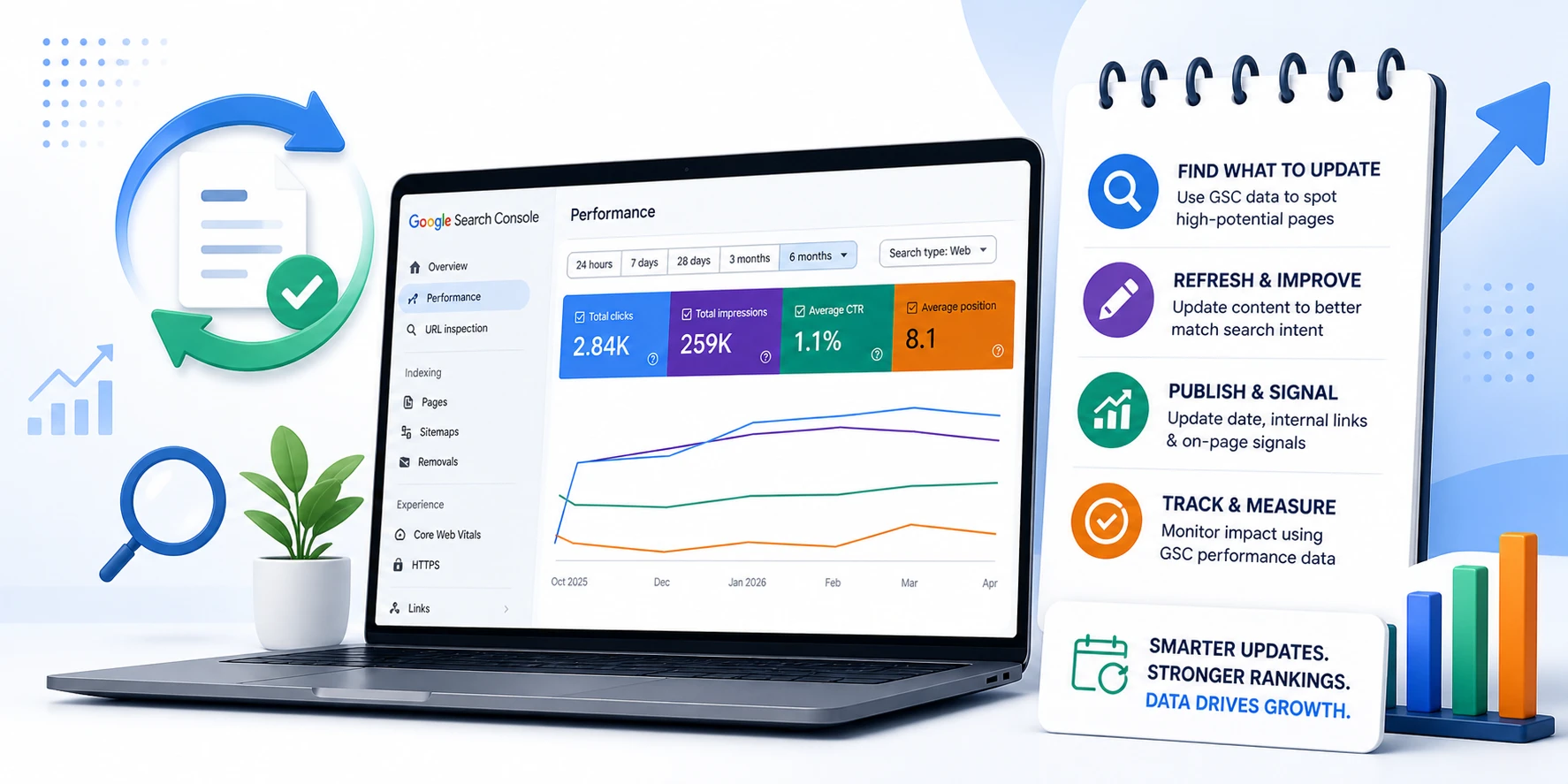
Low hanging keywords are queries your site already ranks for at positions 5–20 with decent impressions but low click-through rate. Find them in GSC by filtering the Performance report for non-branded queries at positions 5–20, then sorting by impressions. These GSC keywords require content updates or title rewrites — not new pages — to move to page one and generate measurable traffic gains in 30–60 days.
Introduction
Publishing new content is the SEO default. It’s also the slowest path to organic growth for any site with existing rankings.
A content refresh SEO strategy works differently. Instead of starting from zero, it strengthens signals that Google has already partially validated. HubSpot data shows 76% of monthly blog views come from older posts — and a well-executed GSC content update can recover 60–80% of the traffic improvement a full rewrite would deliver, in a fraction of the time.
The March 2026 Core Update reinforced this dynamic. Google’s systems increasingly reward pages that demonstrate sustained relevance — not just recency. Content that was strong 18 months ago but hasn’t been maintained is losing ground to competitors refreshing quarterly. This guide gives you the complete GSC-driven workflow to find, prioritize, and execute content refreshes that recover rankings and improve AI citation eligibility simultaneously. To do this accurately, you need a solid foundation in GSC Performance report guide to ensure your filters, query data, and CTR insights are directionally correct from the start.
Key Takeaways
- Content decay is gradual and invisible without date comparison in GSC — pages rarely drop overnight, they erode over weeks as competitors improve and intent shifts.
- The Compare function in GSC Performance is the primary diagnostic tool — use it to isolate pages losing clicks or position before the decline compounds.
- A content refresh SEO update should address the specific GSC signal that’s declining: clicks, impressions, CTR, or position — each points to a different root cause.
- Changing a publication date without changing content provides zero ranking benefit — Google explicitly discounts date updates without substantive changes.
- Every GSC content update should be assessed for AI citation readiness — answer-first paragraphs, FAQ schema, and E-E-A-T signals affect both traditional rankings and AI Overview inclusion.
What Is Content Decay and Why GSC Data Reveals It First
Content decay is the gradual decline in organic visibility for pages that were once performing well. It’s caused by four compounding factors:
| Decay Cause | GSC Signal | What’s Actually Happening |
|---|---|---|
| Search intent shift | Impressions stable, clicks falling | SERP format changed — your page format no longer matches what Google rewards |
| Competitor improvement | Position declining, impressions stable | A competing page improved and displaced yours |
| Information staleness | CTR falling across all queries for the page | Users see the result and choose a newer source |
| Topical gap | New queries appearing at low positions | Searchers want subtopics your page doesn’t cover |
GSC detects decay before traffic tools do because it measures impressions and position — the upstream signals that predict traffic loss 4–8 weeks before clicks actually fall. GA4 shows you the traffic drop after it’s happened. GSC shows you the early warning.
The pattern to watch: stable impressions + declining clicks + declining average position on the same page = intent drift in progress. This combination is detectable 3–4 months before rankings drop significantly.
How to Find Content Decay Candidates Using the GSC Compare Function
The GSC Compare function is the fastest way to surface pages that need a content refresh. It shows per-page and per-query metric changes between two time periods — side by side.
Step-by-Step: Building Your Refresh List
- Go to GSC → Performance → Search Results
- Set Search Type to Web
- Click the Date filter → Compare → Last 3 months vs Previous 3 months
- Go to the Pages tab
- Sort by Clicks Difference (ascending) — this surfaces pages with the largest click decline first
- Export to Google Sheets for scoring
Scoring Refresh Priority
In the spreadsheet, add a Priority Score column. Score each page across three dimensions:
| Dimension | High Priority (3 pts) | Medium Priority (2 pts) | Low Priority (1 pt) |
|---|---|---|---|
| Click decline | More than 30% drop | 15–30% drop | Under 15% drop |
| Current impressions | 500+ per month | 100–500 per month | Under 100 per month |
| Business value | Revenue/conversion page | Lead generation page | Informational only |
Pages scoring 7–9 are Tier 1 — refresh immediately. Pages scoring 4–6 are Tier 2 — schedule within the quarter. Below 4, deprioritize unless the page is strategically important.
Updating only the publication date — without making substantive content changes — provides zero ranking benefit. John Mueller confirmed that Google explicitly discounts date updates without meaningful improvements. Every GSC content update must include at least one of the following: new data or statistics, additional subtopics covering identified query gaps, structural improvements to the page, or updated metadata reflecting current intent.
Reading GSC Signals to Diagnose What Needs Updating
Not all content decay requires the same fix. The specific GSC signal that’s declining tells you exactly what type of content refresh SEO update is needed.
Signal 1: Clicks Declining, Impressions Stable
This is an intent mismatch or CTR problem. The page still appears in search — users are choosing not to click it. Before making changes, apply improve CTR using GSC using a three-type CTR diagnosis to determine whether the issue is format mismatch, weak metadata, or SERP competition.Check the SERP: if the dominant format has changed (e.g., the top 5 results are now comparison tables and yours is a narrative guide), the content format needs restructuring. If the SERP looks similar to before, the title and meta description are losing the click competition.
- Fix: Click the page in GSC → Queries tab → sort by impressions. The top query is the language your title should mirror. Rewrite the title and meta first.
- If SERP format has shifted: restructure the content to match the dominant format — lead with a table, a list, or a direct answer depending on what the top 5 results show.
Signal 2: Impressions Declining, Position Stable
Google is surfacing your page for fewer queries. This usually means competitors have expanded their topical coverage and are appearing for variants your page misses. It can also indicate that query volume for your head term has declined seasonally or permanently.
- Fix: In GSC Performance, filter by the page, open Queries tab, compare the last 3 months vs the previous 3 months. Identify queries that appeared in the earlier period but have dropped or disappeared. These are the topical gaps to fill.
- Add sections or subsections that directly address each missing query. These don’t need to be long — 150–200 words per gap with a targeted H3 heading is sufficient.
Signal 3: Position Declining, Clicks Declining Together
This is the most serious pattern — a competitor or algorithm update has pushed the page down across multiple queries simultaneously. This requires a more comprehensive content refresh SEO response. In many cases, how to find low hanging keywords in GSC becomes critical, because query gaps are also where low hanging keyword opportunities live.
- Audit E-E-A-T signals: add named author attribution, publication date, and last-updated date. The March 2026 Core Update specifically penalized anonymous content without demonstrated expertise.
- Check content depth against top 3 competitors: run the query in incognito and compare subtopics covered. Fill every gap.
- Strengthen internal links: find your 3 most-linked pages and add contextual links to the refreshed page with keyword-relevant anchor text.
The GSC Content Update Checklist
Every content refresh SEO update should work through this checklist before publishing. This sequence ensures the update addresses the actual GSC signal causing the decay — not just superficial improvements.
| Update Layer | Action | GSC Signal It Addresses |
|---|---|---|
| Query gaps | Add H3 sections for queries in GSC that have dropped or newly appeared | Declining impressions, new low-position queries |
| Metadata | Rewrite title using top query language; update meta description | Low CTR at stable position |
| E-E-A-T | Add/update author bio, credentials, source citations, last-updated date | Position decline after core updates |
| Content structure | Match the dominant SERP format (list, table, comparison, guide) | Clicks declining vs stable impressions |
| Internal links | Add 2–3 contextual links from high-authority pages to the refreshed URL | Position decline, low crawl priority |
| FAQ schema | Add or update structured data targeting question-format queries in GSC | AI Overview eligibility, PAA appearances |
| Freshness signals | Replace outdated statistics with current sources; update screenshots | CTR declining — users perceiving the result as stale |
ChatGPT cited 76.4% of pages updated within the last 30 days (Otterly.AI, 2026). Google AI Overviews similarly weight freshness and answer-first structure. Every content refresh SEO update should also include: A 40–60 word direct-answer paragraph immediately below each H2 FAQ schema targeting question queries identified in GSC One original statistic or proprietary data point per major section
Tracking Content Refresh SEO Results in GSC
Measuring whether a GSC content update worked requires a controlled before/after comparison — not a glance at total clicks after publishing.
The Correct Measurement Method
- Record baseline metrics before publishing: clicks, impressions, CTR, average position for the last 28 days
- After publishing, request re-indexing via URL Inspection in GSC
- Wait 28 days — Google needs time to recrawl, re-evaluate, and adjust rankings
- Use GSC Compare function: 28 days post-refresh vs 28 days pre-refresh, filtered to that specific page URL. To go beyond surface-level metrics, GSC vs GA4 guide helps you pair GSC refresh metrics with GA4 engagement data for a complete performance picture.
- Measure at the same average position — a CTR improvement alongside a position improvement is partly a rankings win, not purely a metadata win
Expected timelines by signal type:
| Refresh Type | Expected GSC Signal Change | Timeline |
|---|---|---|
| Title + meta rewrite only | CTR improvement at same position | 7–21 days |
| Query gap sections added | Impression recovery, new query appearances | 4–8 weeks |
| Full content depth + E-E-A-T upgrade | Position improvement across multiple queries | 6–12 weeks |
| Internal link additions | Position improvement, crawl frequency increase | 2–6 weeks |
Conclusion
A content refresh SEO strategy built on GSC data is the highest-ROI optimization activity available to any site with existing rankings. It requires no new URLs, no new link building, and no waiting for Google to discover new content. The signals that predict recovery — impressions, position changes, query appearance and disappearance — are all visible in your GSC data right now.
The workflow is repeatable: use Compare to find decaying pages, read the specific GSC signal to diagnose the cause, apply the correct fix from the update checklist, and measure at 28 days. Run this quarterly — content decay compounds silently, and the teams winning organic search in 2026 are the ones treating refresh as a standing program, not a reactive response to traffic drops.
Combine every refresh with the AI citation layer: answer-first paragraphs, FAQ schema, and E-E-A-T signals. A page that recovers traditional rankings while also becoming citation-eligible in AI Overviews captures traffic from two surfaces simultaneously — and that compounding effect is what makes a content refresh SEO program worth systematizing.
The same principle applies locally: use a Google Business Profile optimization checklist to apply the same systematic approach to GBP optimization as content refresh.
Frequently Asked Questions
What is a content refresh in SEO?
A content refresh SEO update is the process of improving an existing page to recover or improve its organic rankings — without creating a new URL. It involves updating outdated information, filling topical gaps identified in GSC query data, improving E-E-A-T signals, restructuring content to match the current SERP format, and updating metadata. Unlike a full rewrite, a refresh preserves the page’s existing authority signals while addressing the specific factors causing decay.
How do I use GSC to find pages that need a content refresh?
In GSC Performance, use the Compare function: set Last 3 months vs Previous 3 months, go to the Pages tab, and sort by Clicks Difference ascending. Pages with the largest click decline are your primary refresh candidates. Then click each page and open the Queries tab to compare which queries have dropped, appeared, or shifted in position — this tells you specifically what the content update needs to address.
How often should I refresh content for SEO?
Semrush recommends refreshing most blog content every 3–6 months to maintain accuracy and alignment with search intent. In practice, the correct cadence depends on your niche’s rate of change and your content volume. A practical approach: run the GSC Compare workflow quarterly across your full content inventory and refresh any page that shows a 15%+ click decline or a meaningful position drop over the period. High-commercial-value pages should be reviewed every 90 days regardless of decay signals.
Does changing the publication date help SEO?
No — updating only the publication date without making substantive content changes provides zero ranking benefit. Google explicitly discounts date updates without meaningful improvements. A legitimate freshness signal requires actual content changes: new data, updated sections, filled topical gaps, or improved structural elements. If you display a ‘last updated’ date on your page, ensure it reflects genuine content updates — Google’s quality evaluators check whether the date matches the actual content.
How long does it take to see results from a content refresh?
Timeline depends on the type of update. Title and meta description rewrites can show CTR improvements within 7–21 days. Adding query gap sections and new subtopics typically improves impressions and positions within 4–8 weeks. Full content depth upgrades with E-E-A-T improvements take 6–12 weeks for full ranking recovery. Always measure using the GSC Compare function — 28 days post-refresh vs 28 days pre-refresh, filtered to the specific page URL — to isolate the contribution of the refresh from other ranking factors.